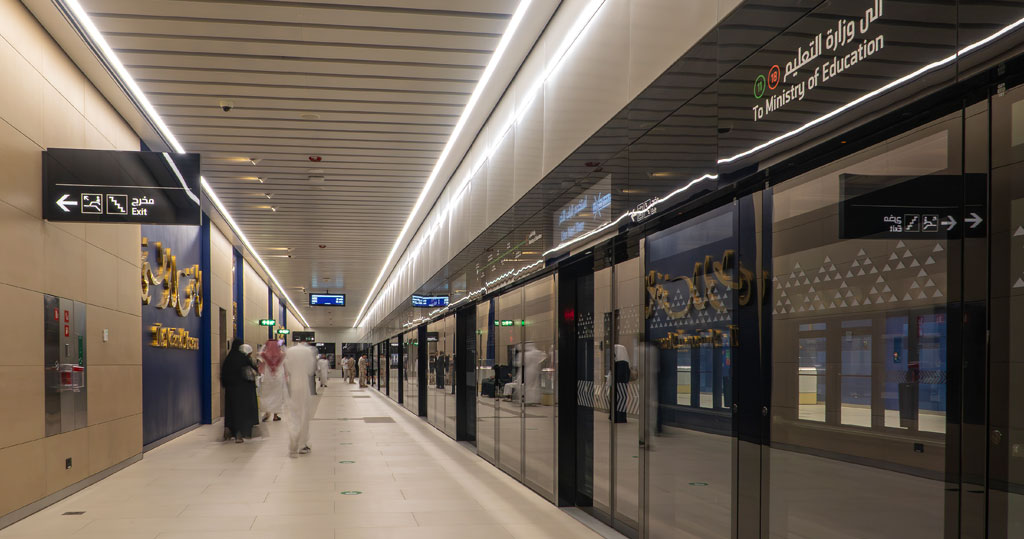
The design and construction of Lines 4, 5 and 6 of the Riyadh Metro has been awarded the Agustín Betancourt International Public Works Award, in its 6th edition, at the 2025 Fundación Caminos Awards. This project, considered one of the largest engineering contracts in the world, was commissioned by the Arriyadh Development Authority (ADA) and took ten years to develop before coming into service.
The Riyadh Metro network was officially opened in November 2024 and consists of a total of six lines, including the three that receive this award. The network has 85 stations, 7 workshops and depots, and covers a total length of 176 km; it also holds the Guinness World Record for the world’s longest driverless metro network.
TYPSA shares in this award as a member of the FAST Consortium, which also includes FCC, Samsung C&T, Alstom, Strukton, Atkins, Setec and Freyssinet as the local Saudi partner.
The award-winning package includes the yellow Line 4, the green Line 5 and the purple Line 6, with a total length of 65 km, 11 underground stations, 17 at-grade stations, 2 workshop-depots and over 26 km of tunnel.
TYPSA had a key role in the development of the project, as lead engineer, playing a fundamental part in the conceptual and preliminary design of the three lines, in a joint venture with the British engineering firm Atkins. Detailed design was also prepared for Line 5, considered the most technically complex due to the challenging geological conditions and variable terrain.
Line 5 has 12 km of single-tube tunnel excavated with TBM, 860 m of C&C tunnel, 11 deep underground stations, 11 ancillary shafts, connections to Lines 1 and 2, and an underground depot measuring 260 m wide by 400 m long. An EPB TBM with rock capabilities and a 10 m excavation diameter was used for the works.
In addition, TYPSA coordinated the tunnel designs for the three lines and the environmental integration in accordance with Saudi legislation and the recommendations derived from the corresponding Environmental Impact Assessment, as well as the design of the road network running parallel to the metro line route. Other notable work carried out included noise and vibration transmission studies, as well as the design of the corresponding mitigation measures.
The development of the six lines of the Riyadh Metro was carried out to improve urban mobility and promote a more sustainable and environmentally friendly transport model, contributing to the city’s economic and social development and to an improved quality of life for its residents.