1. Introduction and background
The São Francisco River Integration Project with the Water Basins of the Northern Northeast (PISF) is Brazil’s largest water infrastructure project, designed to enhance water security in the semi-arid north-east through the controlled transfer of water from the São Francisco River to the water basins of the states of Pernambuco, Ceará, Paraíba and Rio Grande do Norte. The system’s primary objective is to supply water to the population and for livestock farming, complementing the water availability from strategic reservoirs and strengthening integration between state water supply systems. Its catchment area covers approximately 390 municipalities and benefits around 12 million inhabitants in a region of some 450,000 km², characterised by high climatic variability and recurring prolonged periods of drought.
Designed as a structural water resources system, the PISF comprises canals, pumping stations, aqueducts, tunnels, reservoirs and automation systems, enabling the transfer of water to receiving catchments and its subsequent distribution via branch lines and state water supply systems. In addition to the scale of its works, the project is distinguished by the complexity of its planning, execution and operation, which have unfolded over several decades and involve successive stages of studies, design, project management and contract administration. Against this backdrop, this article provides an overview of the technical and operational characteristics of the PISF and highlights ENGECORPS’s contribution across the various phases of the project’s development, from the feasibility studies carried out in the 1990s to the current management and supervision of the water supply systems’ construction works.
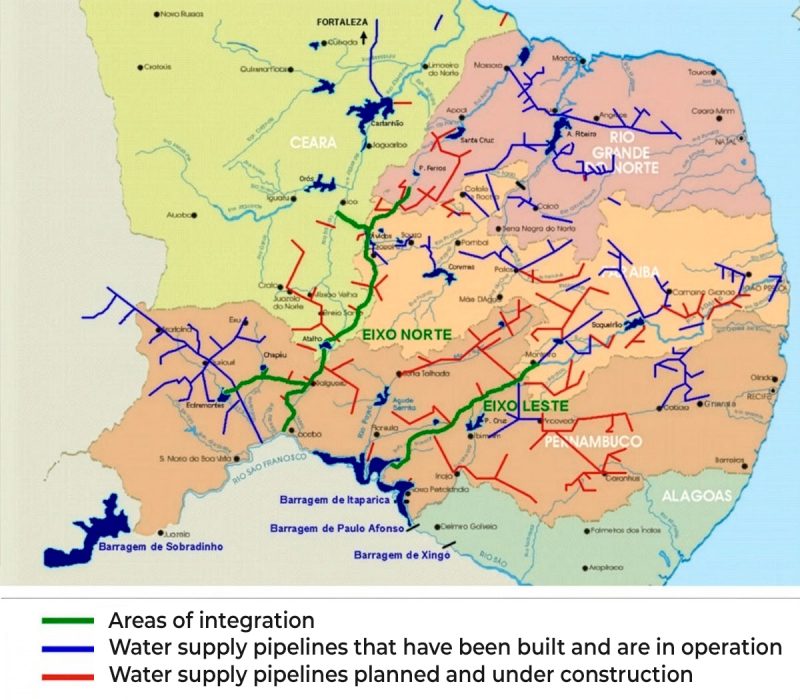
PISF catchment area
2. Technical characteristics of the project
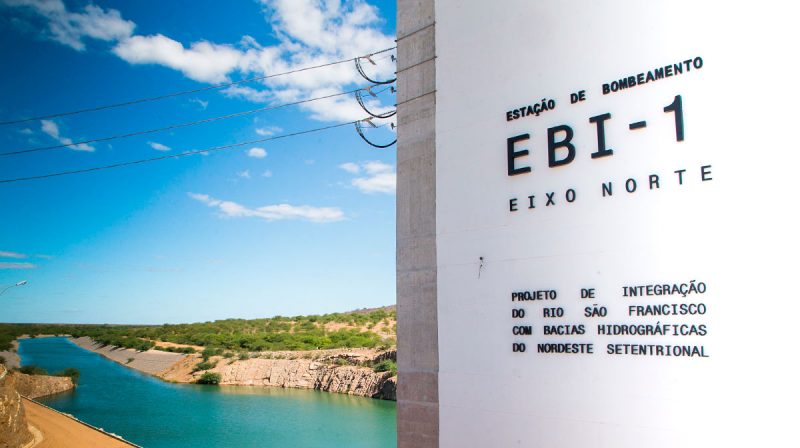
The São Francisco River Integration Project was designed to transfer water from the river to the river basins of the Northern Northeast via a large-scale hydraulic system comprising two independent water conveyance axes: the Northern Axis and the Eastern Axis. The Northern Axis draws water from the São Francisco River in the municipality of Cabrobó (PE) and conveys it to the states of Ceará, Paraíba and Rio Grande do Norte, whilst the Eastern Axis draws water from the Itaparica reservoir in Floresta (PE), primarily benefiting the states of Pernambuco and Paraíba. Together, the two axes comprise approximately 477 km of canals, forming the backbone of the water transfer system’s infrastructure.
The PISF infrastructure comprises an integrated set of civil, hydraulic, electromechanical and automation works, including concrete-lined canals, aqueducts, tunnels, inverted siphons, regulating reservoirs, pumping stations, electrical substations and operational monitoring and control systems. The pumping stations enable significant topographical differences in elevation between the São Francisco River and the receiving basins to be overcome, whilst the strategic reservoirs ensure the regulation of transferred flows and integration with the state water supply systems.
In addition to the main transfer routes, the project is extended by means of diversion branches, such as the Apodi, Agreste, Salgado and Entremontes branches, which increase the system’s territorial reach and enable its connection to the regional water supply systems responsible for distributing water to the beneficiary municipalities. In this way, the PISF constitutes the backbone infrastructure of an integrated water supply system, the effectiveness of which depends on the coordinated operation of the transfer routes, the receiving reservoirs, the branch lines and the water distribution systems implemented by the states.
Key features of the project:
| Feature |
Northern Corridor |
Eastern Corridor |
Total |
| Approximate length of the canals |
260 km |
217 km | 477 km |
| Elevation difference |
190 m |
390 m |
— |
| Water collection |
Cabrobó (PE) |
Floresta (PE) |
— |
| States supplied directly |
CE, PB, RN and PE |
PE and PB |
4 |
| Pumping stations |
3 |
6 |
9 |
| Reservoirs |
16 |
11 |
27 |
| Aqueducts |
8 |
5 |
13 |
| Tunnels |
3 |
6 |
9 |
| Maximum design flow rate |
99 m³/s |
28 m³/s |
127 m³/s |
| Installed pumping capacity (2026) | 24.75 m³/s | 14 m³/s |
38.75 m³/s |
3. Hydraulic operation of the system
The project’s hydraulic operation is based on integrated water resources management, balancing water availability in the São Francisco river basin with the demands of the recipient states. Unlike conventional water supply systems, the PISF operates dynamically, with pumping governed by the rules set out in the concession for the right to use water resources and in the Annual Management Plan, a document that defines the volumes made available, the operational schedule and the distribution of flows amongst the various delivery points.
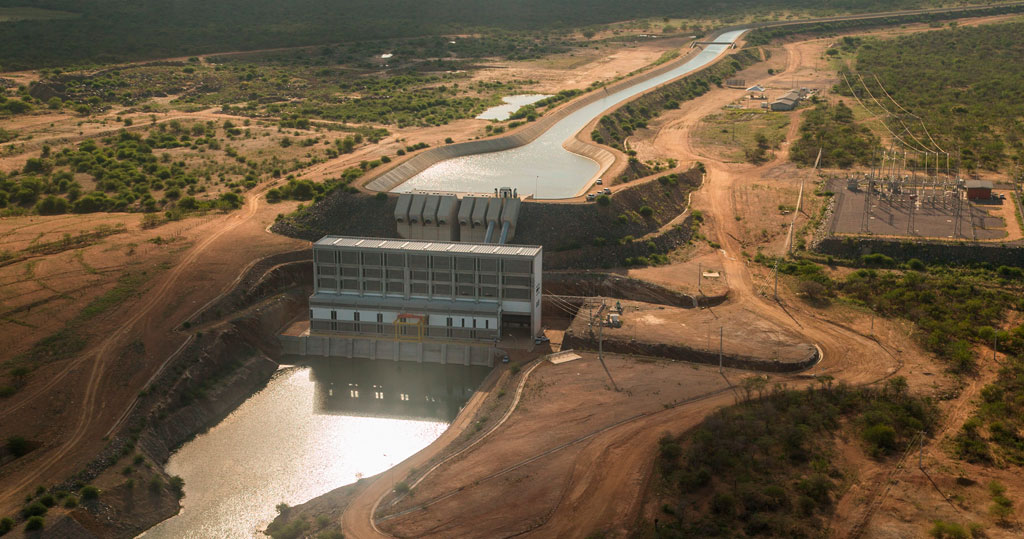
Northern Axis of the São Francisco River Integration Project
The operational rules established by the National Water and Basic Sanitation Agency (ANA) prioritise human consumption and the supply of water for livestock, in line with the National Water Resources Policy. Use for other purposes is subject to water availability and the system’s operational constraints. The annual schedule takes into account, amongst other factors, the inflows to the São Francisco River, the volumes stored in strategic reservoirs, the requirements of state operators, the installed capacity of pumping stations, and the maintenance of the ecological flows necessary for the preservation of the basin’s multiple uses.
From an operational perspective, the project was designed for a maximum transfer capacity of 127 m³/s, distributed between the Northern and Eastern Corridors, although normal operation takes place at significantly lower flow rates, consistent with actual demand and the basin’s water availability. During periods of greater water availability, pumping can be increased up to the limits established by the water use concession and by the system’s installed capacity. In situations of prolonged drought, operations are adjusted to preserve the sustainability of the São Francisco River, whilst simultaneously ensuring that the priority demands of the beneficiary states are met.
The operation of the PISF is continuously monitored using surveillance systems, telemetry and continuous flow measurement at the intake and delivery points, enabling real-time monitoring of hydraulic performance and water availability. The operational data serves as the basis for the periodic review of the Annual Management Plan and for decision-making by the federal operator, the state operators and the ANA, ensuring transparency, traceability and operational safety for the project.

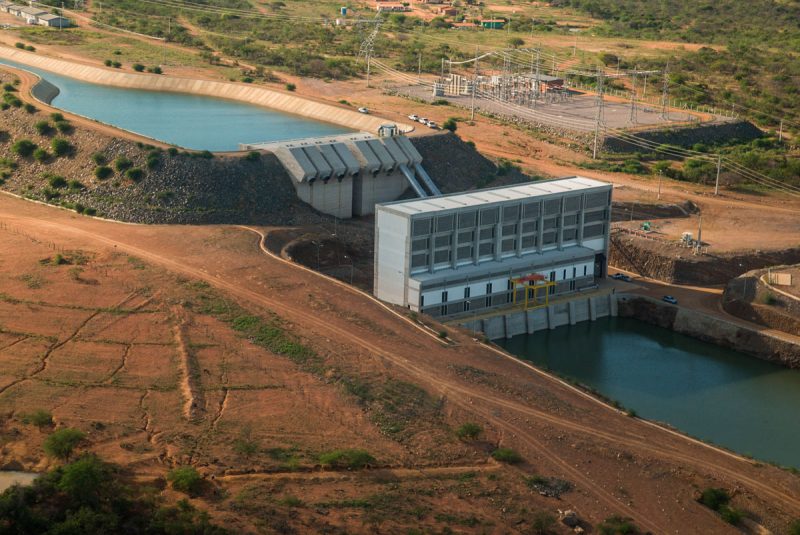
Pumping station (North Axis)
4. ENGECORPS’ involvement throughout the implementation of the PISF
The project’s implementation has spanned more than three decades, a period during which the planning, design, execution and operation phases have required a high degree of technical specialisation and continuity in the provision of engineering services. In this context, ENGECORPS has been continuously involved in feasibility studies, project development, economic and financial modelling, the management and supervision of implementation, and contract administration, contributing to the consolidation of the technical solutions adopted and the execution of key components of the system.
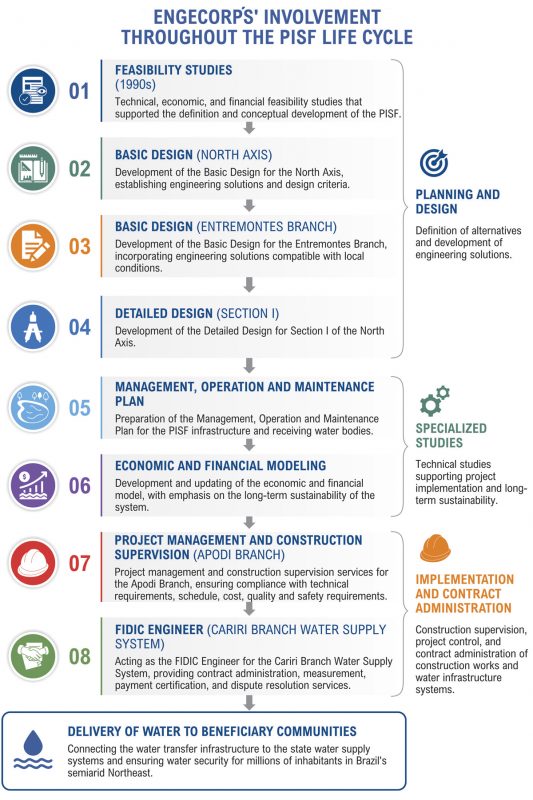
The company’s involvement began in the 1990s with the preparation of technical, economic and financial feasibility studies, which formed the basis for the assessment of water integration options and contributed to the finalisation of the configuration adopted for the project. Subsequently, activities relating to the engineering designs were carried out, notably the preparation of the preliminary design for the Northern Corridor, the detailed design for Section I, and the preliminary and detailed design for the Entremontes Branch, incorporating solutions compatible with the hydraulic, geotechnical and construction characteristics of the regions traversed. More recently, it has once again been involved in the project by updating the economic and financial modelling studies, providing data to improve the management and operational sustainability of the system, as described below.
4.1. Economic and financial modelling studies
Following on from its involvement in the development of the infrastructure, ENGECORPS led the consortium of consultancy firms commissioned by the National Bank for Economic and Social Development to structure the technical, economic and financial modelling for the PISF concession, a pioneering initiative aimed at involving the private sector in the operation of the system’s raw water supply infrastructure.
The modelling was structured on the basis that the purpose of the concession is the provision of raw water supply services, whilst the management of water resources, the determination of the flow rates to be supplied and the granting of water use rights remain the responsibility of the public administration.
The studies comprised an assessment of the technical, operational, economic-financial and institutional feasibility of the concession, including the definition of the service delivery model, the structuring of remuneration mechanisms, the allocation of risks, the preparation of demand and operating cost projections, and the definition of performance indicators and service levels. The modelling also took into account the operational specificities of the PISF, such as the hydrological variability of the São Francisco River, the exploitation regulations established by the ANA, the inter-federal management of water demands, and the integration between the Northern and Eastern Corridors and the state water supply systems.
In addition to developing a concession model tailored to the project’s unique characteristics, the studies provided the technical data necessary to ensure the system’s long-term operational and economic-financial sustainability, whilst preserving its primary objective of guaranteeing water security for the beneficiary populations.
4.2. Management and supervision of works – Apodi Branch
During the construction phase, ENGECORPS played a key role in the management and supervision of works on the Apodi Branch, an infrastructure project designed to extend the territorial reach of the PISF and integrate new areas into the water transfer system.
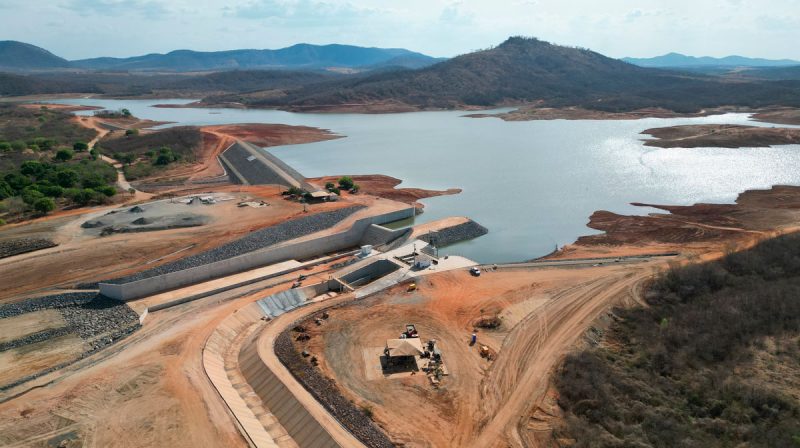
Redondo Dam
The Apodi Branch is responsible for transporting a flow of 40 m³/s from the PISF’s Northern Axis to the states of Ceará and Rio Grande do Norte. It is approximately 115 km long and includes a dam and a tunnel. The Salgado Branch, which supplies the state of Ceará, branches off from the Apodi Branch.
The activities carried out include planning and monitoring the execution of the works, technical supervision, inspection of civil and electromechanical works, technological control, contract management, environmental monitoring and physical and financial control, ensuring that the works comply with the design requirements, technical specifications and quality standards established for the infrastructure.
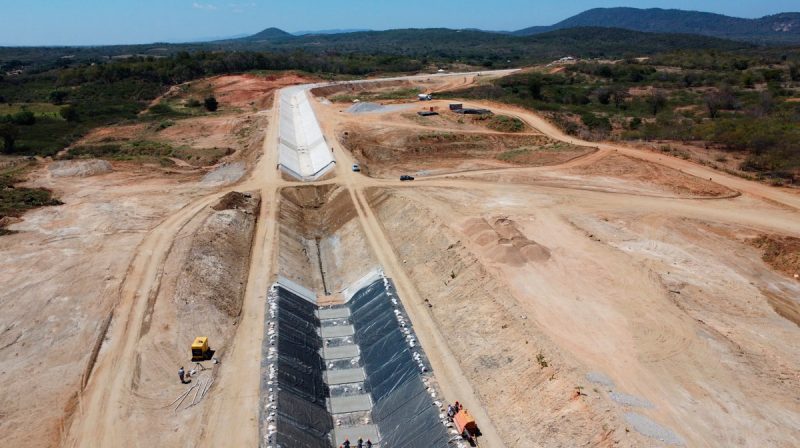
Construction of a section of canal
4.3. FIDIC Engineer – Cariri Branch water supply system
This work continues with the Cariri Branch water supply system in Paraíba, a project representing one of the final stages of the infrastructure chain initiated on the São Francisco River, channelling water from the PISF to the water supply systems responsible for directly supplying the beneficiary communities.
The system is designed to supply drinking water to 18 municipalities, 2 districts and 37 community supply points (public fountains), whilst also incorporating measures relating to socio-environmental management, public communication and involuntary resettlement, in accordance with Brazilian legislation and the World Bank’s requirements.
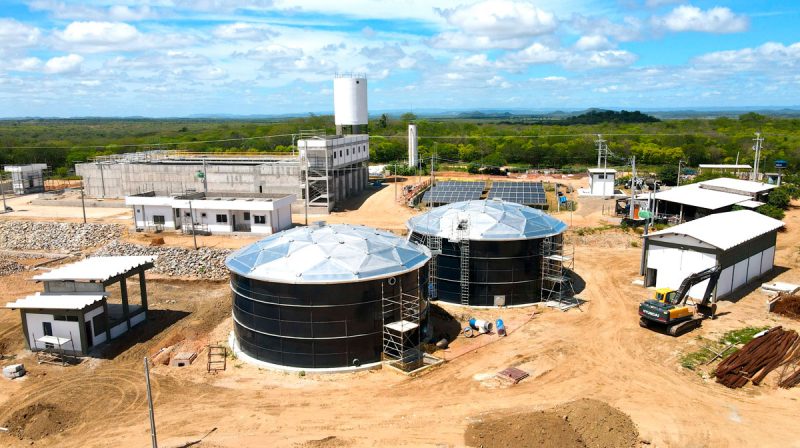
Water Treatment Plant (WTP) – Monteiro
The infrastructure comprises an integrated system consisting of a raw water intake, a pumping station (EBAB), a main pipeline, a water treatment works (ETA), 12 treated water pumping stations (EBAT), 360 km of main and secondary pipelines, and 18 regulating reservoirs. The intake was designed for a pumping capacity of 410 l/s, equivalent to the WTP’s nominal treatment capacity.
Under this contract, which is being carried out in accordance with FIDIC contract conditions, ENGECORPS acts as the Principal Engineer, assuming responsibility for contract administration, the certification of measurements and payments, the analysis of claims, risk management and the technical resolution of disputes between the employer and the contractor. This involvement clearly demonstrates the continuity of ENGECORPS’s involvement throughout the entire life cycle of the infrastructure, from its conception to the implementation of the systems that deliver the benefits of water integration for the semi-arid north-east. By connecting the water transfer infrastructure to the state water supply systems, this phase marks the point at which water actually reaches the beneficiary communities.
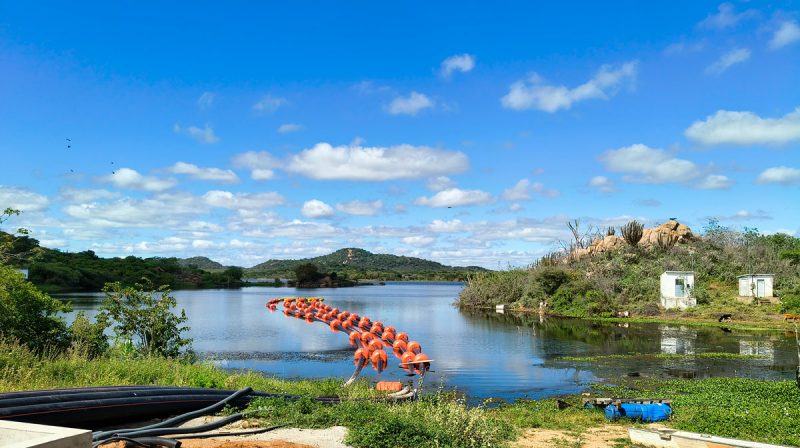
Water Intake – Poções Reservoir
4.4. Management, Operation and Maintenance Plan (PGOM) for the infrastructure and receiving water bodies of the PISF
ENGECORPS, as part of a consortium, is developing the Management, Operation and Maintenance Plan (PGOM) for the infrastructure and receiving water bodies of the São Francisco River water transfer scheme in the state of Paraíba, also covering the Canal da Redenção and the Canal das Vertentes Litorâneas.
The study area comprises the three river basins receiving water from the PISF in the state: the Paraíba River basin, which covers approximately 53 per cent of Paraíba’s territory and receives water from the Eastern Corridor; the Paraíba portion of the Piancó-Piranhas-Açu river basin, corresponding to around 23 per cent of the state’s area and supplied by the Northern Corridor; and the North Coast River Basins, which cover 13.1 per cent of Paraíba’s territory, comprising the Camaratuba, Mamanguape and Miriri river basins, which are supplied by water diverted via the Canal de las Vertientes Litorales.
The aim of the project is to ensure the efficient management and operational, institutional and financial sustainability of the water transfer system in the state of Paraíba, by establishing procedures for the operation and maintenance of the infrastructure, as well as defining guidelines and methodologies for calculating tariffs for the use of transferred water, thereby guaranteeing the necessary resources for the conservation and operation of state assets.
Activities include carrying out an assessment and characterisation of the catchment area, including technical visits to the ten reservoirs receiving water from the PISF in the state, the Canal da Redenção and the Canal das Vertentes Litorâneas. Operational scenarios will be developed, studies will be carried out to balance water supply and demand, coordination with the main water users will be promoted, and criteria for the allocation of water resources will be established.
Next, pre-operational proposals and the PGOM will be drawn up, covering the definition of routines and procedures for the operational control of equipment, dam safety inspections, water demand management, monitoring of unauthorised water abstraction, and the implementation of a training programme for technicians at the Paraíba Water Management Executive Agency.
The final stages involve defining the tariff structure applicable to end users and to the Paraíba Water and Sewerage Company, which is responsible for urban water supply in the state, as well as drawing up the Decision-Making Plan. This instrument will establish the decision-making process and timetable for drawing up the Annual Operational Plan, enabling the State to formalise, in a technical, well-founded and transparent manner, the annual requests for water volumes made available by the federal operator.
5. Conclusions
The São Francisco River Integration Project represents one of the most complex water infrastructure schemes ever developed in Brazil, incorporating challenges related to long-term planning, the development of multidisciplinary projects, the execution of large-scale works and the integrated operation of water systems spread across different states of the Federation. Its successful implementation demonstrates that water security in highly vulnerable regions depends not only on the deployment of physical infrastructure, but also on consistent processes of planning, management and technical administration throughout the project’s entire life cycle.
In this context, ENGECORPS’s involvement has, to a large extent, mirrored the evolution of the PISF itself. Beginning during the project’s design and feasibility assessment phase, it has continued with the development of engineering projects, has expanded to include the management and supervision of the construction of the Apodi Branch, and currently encompasses contractual administration, acting as the FIDIC Engineer for the Cariri Branch supply system, a project responsible for channelling water from the PISF to the supply systems that directly serve the beneficiary communities.
This track record highlights ENGECORPS’ strategic role as an integrating element between planning, design, execution, management and contractual administration of major infrastructure projects. Beyond ensuring the technical quality of the solutions adopted, its ongoing involvement throughout the various phases of the project lifecycle helps to reduce risks, promote greater efficiency in the implementation of investments and ensure that infrastructure works fulfil their purpose safely, sustainably and over the long term.