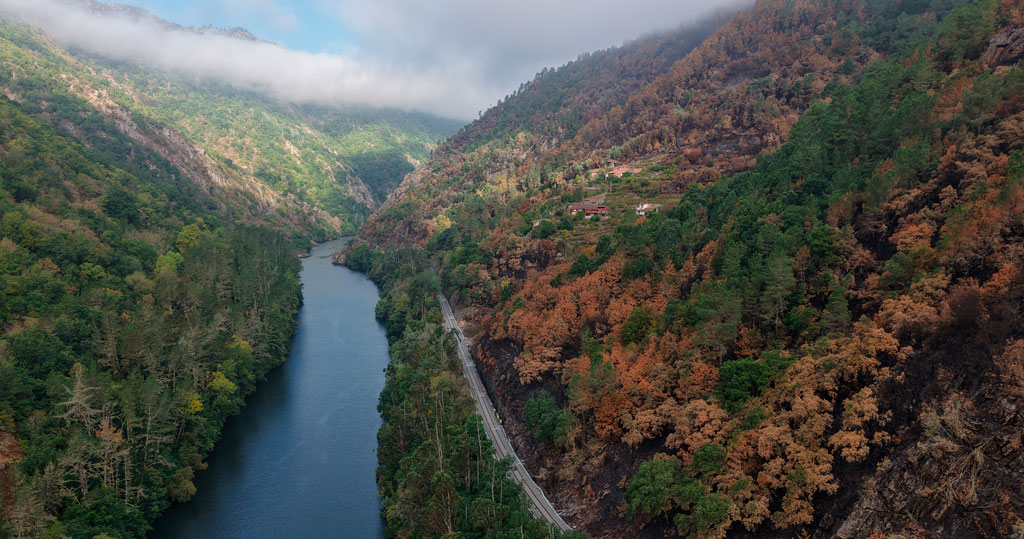
In recent years, Galicia’s railway network has faced situations of extreme vulnerability, characterised by rugged terrain and unprecedentedly severe weather conditions. Against this backdrop, TYPSA has established itself as Adif’s technical point of reference in the region, leading efforts in technical assistance, supervision and the design of engineering solutions for highly complex emergency works, where speed and adaptability are vital to ensuring the safety of the railway system.
The increase in incidents affecting Galicia’s railway infrastructure is not an isolated occurrence, but rather the result of interconnected geographical and technical factors. Galicia has an extensive conventional and metre-gauge (RAM) network that extends far beyond the high-speed lines and the Atlantic corridor. Iberian-gauge lines such as the 800 (León–A Coruña) and the 810 (Chapela Junction–Monforte) are vital arteries for freight traffic, whilst the 740 metre-gauge line (Ferrol–Ribadeo) passes through areas of great geological and topographical complexity.
The nature of these lines presents a constant challenge; many sections run halfway up the slopes along the banks of the Miño and Sil rivers, wedged into narrow canyons where the upper embankment can reach heights of over 100 metres. Added to this are ageing metal structures, the presence of unstable trees and the lack of drainage systems on the crest of the embankments on adjacent plots, where smallholdings predominate, leading to uncontrolled runoff that saturates the cuttings. In terms of weather, storms have been recorded with rainfall totals of up to 600 l/m² in a single month, saturating the ground and causing, following cycles of frost, the rupture of highly fractured rock masses.
In 2019, we began our work at the Regional Office on emergency works contracts with our client, Adif. From the very start, our dear colleague Pablo López Fuentes instilled in us an approach to this work based on a fundamental principle: prioritising the client and responding to their needs, especially those of a more urgent nature, something that fits very well with this type of project.
TYPSA has been playing a leading role in Galicia through its emergency response operations on railway infrastructure
Pablo, whose father worked on the railways, provided us with invaluable insight thanks to his childhood experiences linked to Adif’s maintenance work in Galicia, which has always spurred us on to approach these contracts with a great sense of responsibility and dedication.
Consequently, in the event of an emergency, the entire regional management team in Galicia becomes involved, collaborating and developing the best solutions, whilst tackling any complications that may arise. In many cases, areas are inaccessible by road, forcing us to deploy dual-mode vehicles and transport materials via the railway line itself, which limits the materials and resources that can be used in the solution being devised; or a large part of the work is carried out during the night-time hours or during power cuts to maintain daytime services, meaning that technicians are forced to adjust their working hours and coordinate their efforts.
It should be noted that emergency works are contracts that arise unexpectedly and are unplanned, making it all the more necessary for the entire regional management team to work together so as not to neglect the other ongoing contracts.
Drawing on its experience, TYPSA provides technical solutions that prioritise minimising disruption to rail operations, designing plans that restore the track to safe conditions within the shortest possible time, often by imposing temporary speed restrictions whilst the permanent works are carried out or by maintaining train services throughout the entire duration of the works.
Over the past few years, we have been carrying out structural works on bridges and tunnels, stabilising cuttings and slopes, and responding to adverse weather conditions and even accidents. To give an idea of the variety of these projects, the most notable features of each are summarised below:
Structural works on bridges and tunnels
- Viaduct over the River Tea (Line 810). Year 2019: Following an inspection in accordance with instruction ITPF-05, Class 1 damage was detected which compromised the load-bearing capacity of this Pratt-type steel structure. TYPSA supervised a highly complex repair operation which included the replacement of chords, the renewal of the joist-to-chord and upper corner connections, as well as the stiffening of critical joints and the replacement of deteriorated gussets. Most of the work was carried out during the day whilst allowing traffic to flow, as it involved the lower deck beneath which a work platform was installed, and during night-time maintenance windows for those tasks incompatible with railway operations. In addition, the four movable bearings were cleaned and lubricated, lag bolts were replaced in the sleeper fixings, and damaged areas were repainted.
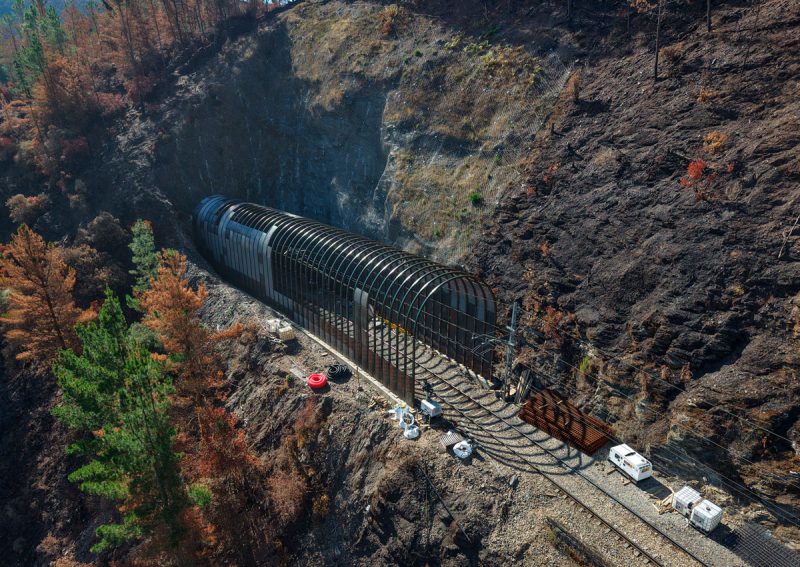
- Tunnel 62 (Line 800). Year 2024: A major rockfall occurred at the tunnel exit between San Clodio and Monforte, which was subsequently struck by an Alvia train. The landslide completely covered the track bed and toppled catenary poles. The solution proposed by TYPSA involved extending the tunnel portal by means of a 50-metre-long cut-and-cover tunnel using HEB-140 trusses and Bernold sheet metal with shotcrete. Prior to this, to stabilise the upper rock mass before constructing the false tunnel, the slope was reinforced using long passive steel bolts, ranging from 2 to 6 metres in length, and triple-twist mesh reinforced with steel cables.
Stabilisation of cuttings and slopes
- Barqueiro cutting (Line 740). Year 2020: Following the derailment of a FEVE train caused by a rockfall and its subsequent collision with an overpass, the instability of the phyllitic materials was analysed. A solution was adopted involving the general re-sloping of the cut, reducing the angle from the original 65° to 45°. The works involved stabilising an area of 3,687 m² and excavating over 4,100 m³ of material. Finally, high-strength triple-twist wire mesh was installed, firmly anchored at the top and bottom using corrugated steel bars, and drainage in the area was improved. It was also necessary to fell large trees in the area.
- Freixeiro Cuttings (Line 800). Year 2020: The dislodgement of rocks by an Alvia train on a steep slope leading down to the River Lor required urgent intervention. The area had lost its vegetation cover following a series of previous fires, exacerbating the risk of rockfall. TYPSA supervised the stabilisation of 6,528 m² of slope and the installation of a combination of triple-twist mesh and a steel cable net anchored with bolts up to 3 metres long. In addition, the existing static retention basins, which had become silted up, were emptied and cleaned to allow for the controlled passage of future sediment, and four-metre-high dynamic barriers were installed.
- San Sadurniño Cutting (Line 740 – RAM). Year 2020: Following the detection of instability during technical inspections, work was carried out on a 310-metre section of the cutting between kilometre markers 18+550 and 18+860. The works involved the manual clearing of 3,900 m² of slope to remove unstable rock wedges and the installation of surface protection mesh reinforced with bolts to stabilise the detected failure planes. Due to the difficult access, it was necessary to bring in fill material to create access routes for the machinery.
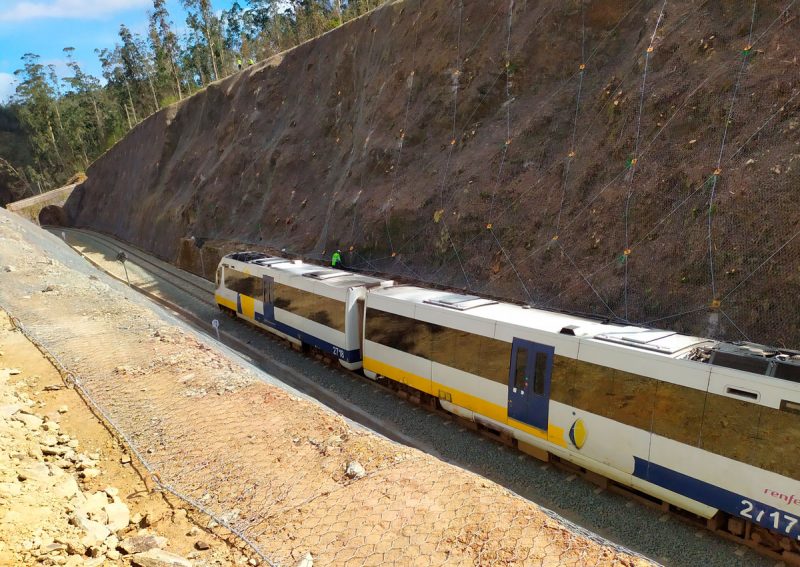
- Meirama Cuttings (Line 822). Year 2022: A landslide was seriously threatening access to the southern portal of the Meirama tunnel. TYPSA’s solution included a 7-metre-high riprap wall and a system of 960 metres of California drains drilled to a depth of 12 metres to lower the water table. A 4-metre-deep drainage trench was also excavated at the crest, and the slope was hydroseeded with coconut fibre matting to curb surface erosion. The entire slope was fitted with topographical monitoring equipment to enable continuous tracking of movements.
Response to weather events and accidents
- Wagons at Sobradelo (Line 800). Year 2020: Following the derailment of a freight train, during which wagons fell down an embankment towards the River Sil, TYPSA supervised the operation to remove them, as well as the repairs to the railway infrastructure. It was necessary to prepare 400 metres of track bed to allow access for and the positioning of 80-tonne self-propelled cranes tasked with removing the wreckage. Subsequently, the company supervised the complete reconstruction of 250 metres of track and the replacement of the overhead line and safety installations damaged by the accident.
- Frieira Sinkhole (Line 810). Year 2021: Torrential rain caused a masonry wall to collapse, leaving a 12-metre-long sinkhole with the track hanging over the void. TYPSA coordinated an immediate response, working round the clock to provisionally rebuild the platform using a breakwater wall and gravel fill; this temporary solution enabled traffic to resume. The permanent solution consisted of a wall of 50 micropiles, each 127 mm in diameter and approximately 20 metres deep, braced by tie beams. To reinforce this wall, a second wall of driven rails was constructed on the opposite side of the platform, connected to the micropile wall by rails laid transversely across the track. A new cross-drain with a diameter of 960 mm and stepped downpipes was also installed to drain runoff from the flyover.
- Heavy rainfall in 2023 (January). Year 2023: In January, heavy rainfall caused multiple instances of instability in the provinces of Lugo, Ourense and Pontevedra, forcing the suspension of traffic between Ourense and Guillarei. TYPSA designed and supervised numerous slope stabilisation and support works on lines 800, 810 and 822, with the works divided into three lots due to their scale and their widespread distribution across the region. The works included driving rails into embankments to temporarily consolidate the track bed and ballast, micropile screens, pile screens, bolted support systems, triple-twist mesh, geogrids and cables, riprap walls, drainage works, as well as track works such as clearing loose ballast and replacing sleepers.
- Storms of 2023 (November). Year 2023: In November, the community once again suffered a series of storms that severely affected the infrastructure. In this instance, lines 800 and 810 again sustained damage to embankments, which had to be repaired. In this instance, the works involved the extensive felling of trees posing a risk of falling onto the infrastructure on line 810.
Work in progress
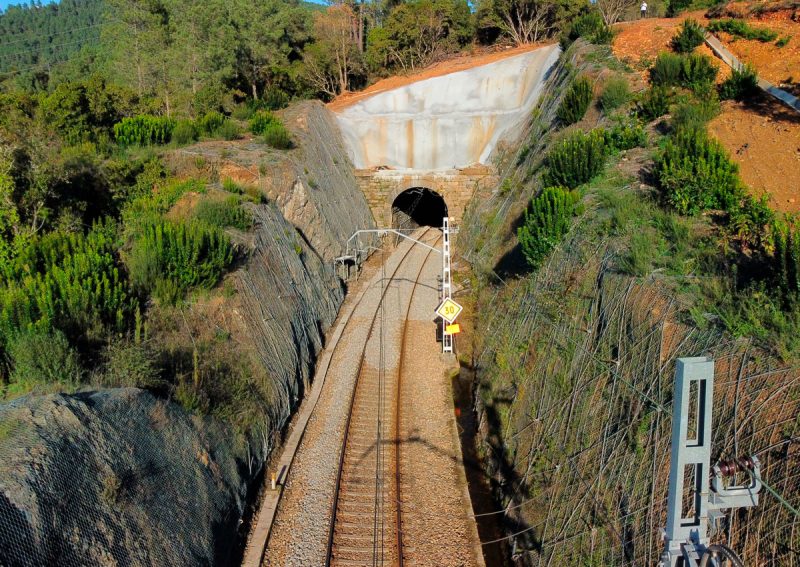
- Monforte fires (August 2025). TYPSA is overseeing the restoration work on the infrastructure affected by a series of fires that occurred in the region during the summer of 2025. Following the damage sustained to the railway infrastructure and superstructure, it is necessary to fell trees in the burnt areas to prevent them from falling onto the track, whilst promoting the regeneration of the area affected by the fires by leaving the biomass scattered on the ground where possible. Also necessary is the repair of trench supports, the replacement of wooden sleepers and level crossings; together with cleaning, galvanising and identifying catenary supports; replacing cabling and LAC suspension and anchoring assemblies; repairing fibre-optic cables, communications cables, track circuits, power cables and conduits, in order to restore block systems and interlocking mechanisms. All work will be carried out whilst the lines remain in operation.
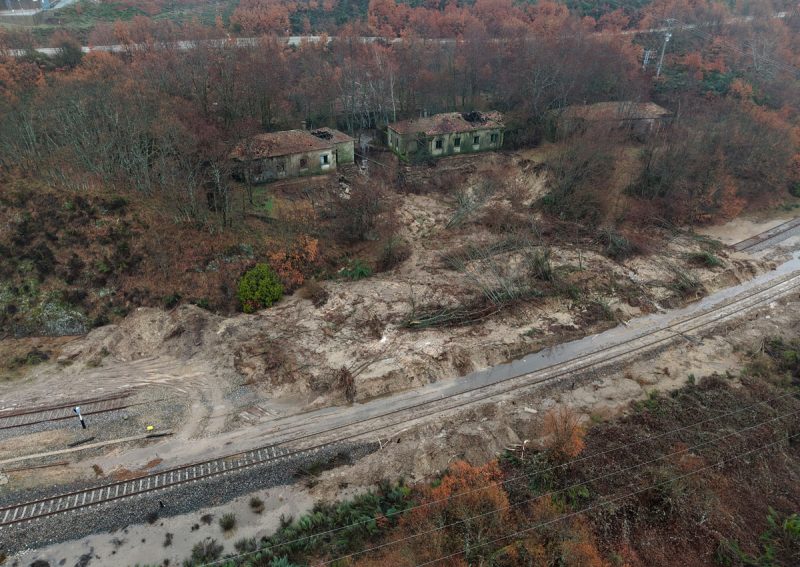
- February 2026 storms. Work is currently underway in response to the state of emergency declared following the recent storms to stabilise two sections of railway lines 810 and 822. In the case of the Barbantes embankment, a landslide occurred on the cleared side, 18 metres high, in the section halfway up the slope. To protect the national road running above the railway line, a micropile retaining wall will be constructed. On the slope where the landslide occurred, a support system using bolts and geogrid will be installed to prevent further material from falling onto the track. At Lubián station, a landslide occurred which affected the track and some old buildings owned by Adif; once the displaced material has been cleared, riprap walls will be constructed. Drainage in the area will be improved by installing a new transverse drainage structure on the track and channelling water from the hillside.
All this experience has enabled TYPSA to consolidate its knowledge and expertise, with the aim of continuing to provide the client with an immediate, appropriate response tailored to their needs, and thereby further strengthening confidence in the design and supervision of this type of project in the future.
With the growing demand for passenger and freight transport, the growing complexity of infrastructure maintenance and the increasingly evident impact of climate change, TYPSA aims to remain a strategic partner of Adif in the region, providing new solutions that enable a swift and reliable response to the new challenges facing the rail network.