Introduction and background
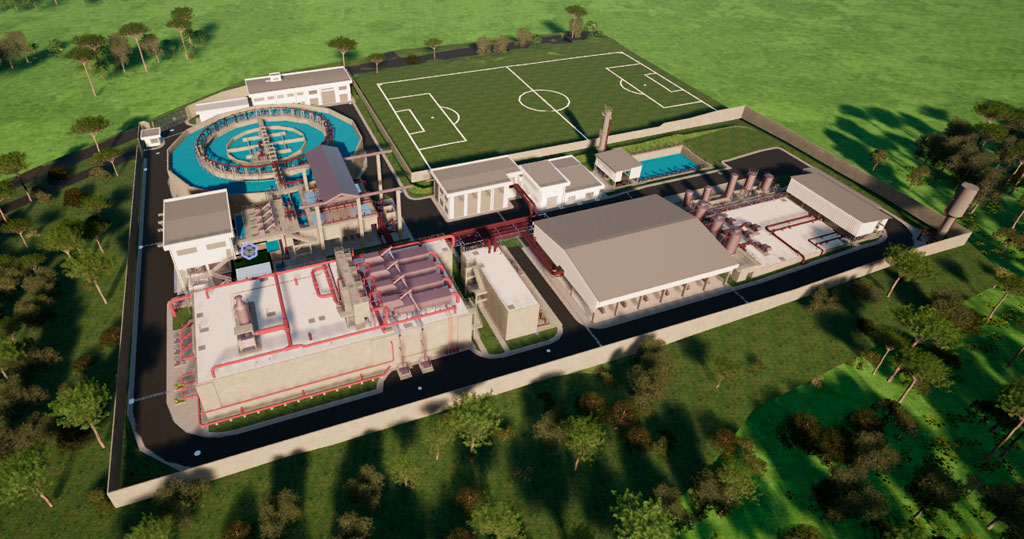
The Vitória Reclaimed Water Production Plant (RWPP) project, EPAR Vitória Reuse Water, is the result of a public-private partnership promoted by the state-owned basic sanitation concessionaire, Compañía Espírito-Santense de Saneamiento (CESAN), which covers the municipalities of Vitória and Serra in the state of Espírito Santo. This initiative represents a significant milestone for the region’s water resilience in the face of the growing water scarcity observed in recent years.
The implementation of the system will provide greater water security for the Greater Vitória industrial and port hub, allowing part of the water resources currently allocated to industrial supply to be redirected to public supply, directly benefiting the population.
ENGECORPS has been responsible for the comprehensive development of the RWWP’s detailed design, including the multidisciplinary design of the civil, hydraulic, electromechanical, electrical, and automation and instrumentation works, based on the process design and the technical specifications for the equipment provided by Veolia.
ENGECORPS’s work on the Vitória RWPP demonstrates its ability to transform a highly complex technological concept into a complete and integrated detailed design, enabling one of the country’s most significant water reuse projects. This project brings together advanced treatment technologies, sophisticated hydraulic and electromechanical solutions, a high degree of automation and major infrastructure, contributing directly to water security, sustainability and the strengthening of the circular economy in the Vitória metropolitan area, in the state of Espírito Santo.
RWPP’s technological solution
RWPP’s core technology is the Membrane Bioreactor (MBR) process for the biological treatment of domestic effluent, combined with a two-stage reverse osmosis final treatment system, capable of producing reclaimed water to a high standard of quality to meet the demands of industrial processes.
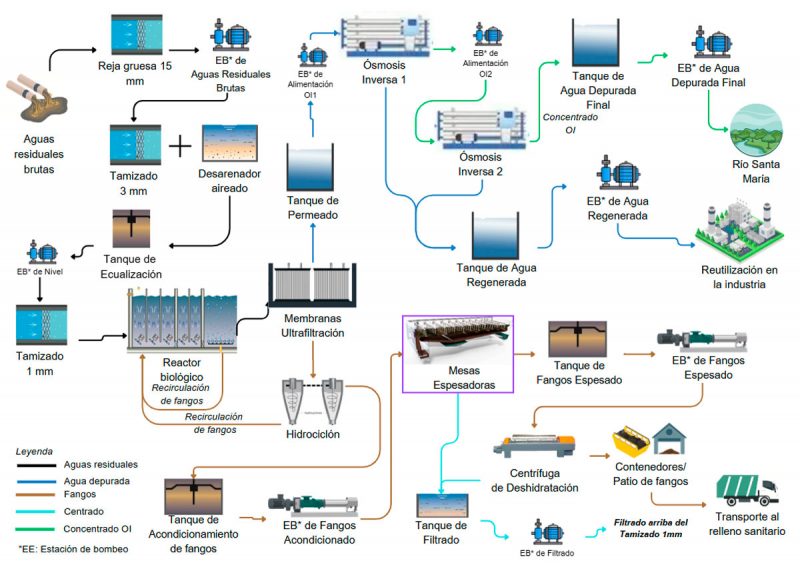
The plant has been designed to treat an average flow rate of 450 l/s and a maximum operational flow rate of 675 l/s, whilst the pre-treatment systems and some hydraulic units are designed to handle peak flow rates of up to 800 l/s.
The process comprises the following units: screens, grit chambers and sieves.
Bar screens, grit chambers and screening
Preliminary treatment consists of bar screens, screening and grit removal systems designed to remove coarse solids, sand, fibrous materials and oils, thereby preventing damage to the membranes installed downstream.
Pre-treatment skids have been designed to handle a peak flow rate of 800 l/s, comprising screens with a mesh size of 3 mm and aerated grit chambers. The flow then passes through a second screening stage, with a mesh size of 1 mm, designed to retain smaller solids and any remaining fibrous materials.
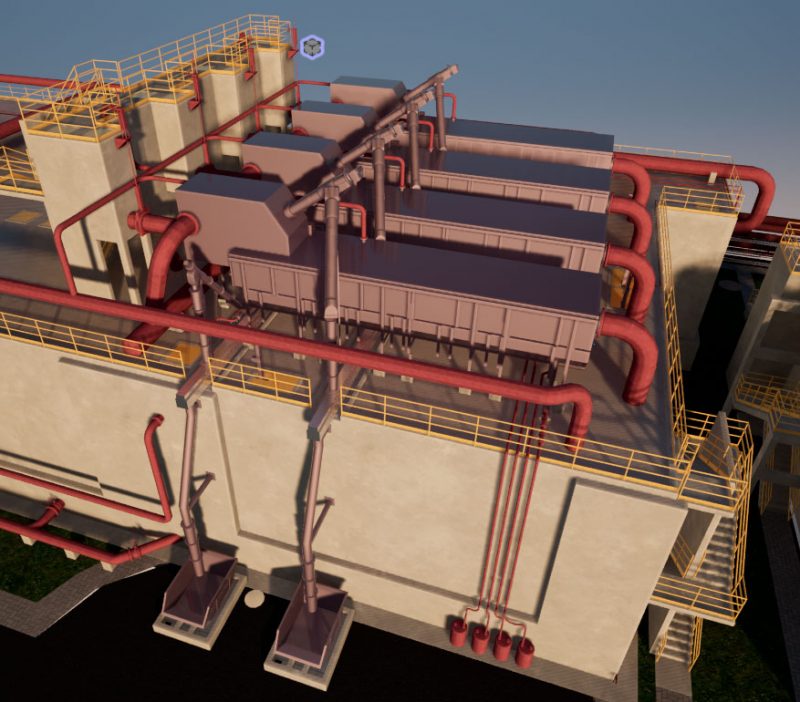 Biological Treatment (MBR)
The biological treatment consists of a circular reactor divided into three sequential compartments, anaerobic, anoxic and aerobic zones, forming a system based on the Modified UCT (University of Cape Town) process for the biological removal of nutrients, followed by four tanks with ultrafiltration membranes, which are responsible for the solid-liquid separation of the mixed effluent.
In addition to the removal of organic matter, the process has been designed to achieve the biological removal of nitrogen and phosphorus, utilising prolonged aeration and a hydraulic configuration of the aerobic zone operating under a piston flow regime.
To complement the biological removal of phosphorus, a ferric chloride dosing system has been provided.
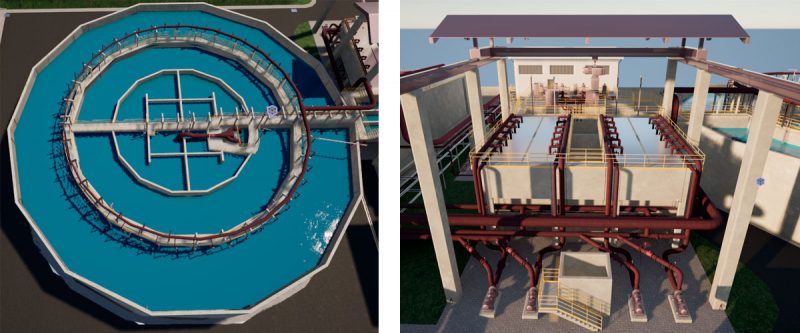 UCT bioreactor and ultrafiltration membrane tank
Final polishing treatment
Final polishing is carried out using a two-stage reverse osmosis system, a solution that provides high-quality treated water and greater efficiency in permeate recovery.
The effluent from the MBR system initially feeds a set of six reverse osmosis skids. The concentrate generated in this first stage is directed to a second set of six skids, thereby increasing the system’s overall recovery rate. The permeate produced in both stages is directed to the reclaimed water storage tank, from where it will subsequently be pumped to industrial consumers.
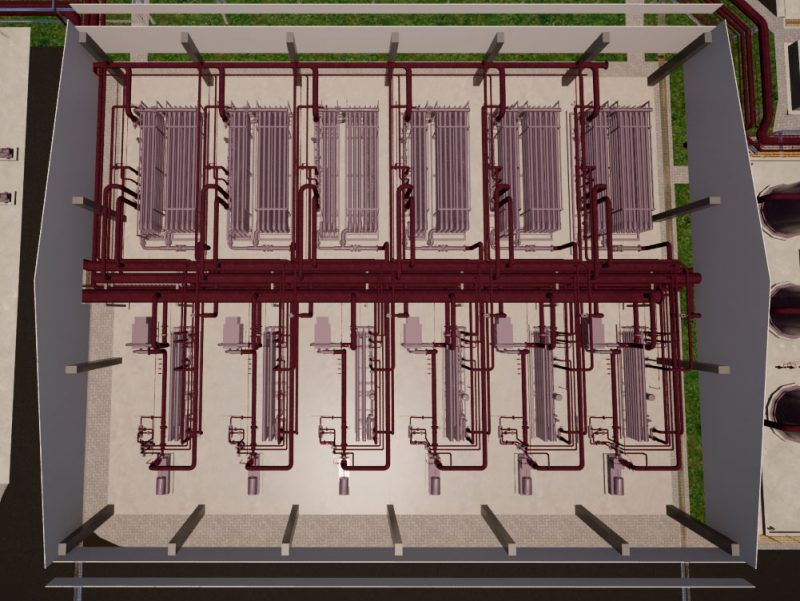 Sludge treatment
The sludge generated in the biological process undergoes thickening and mechanical dewatering using thickening tables, followed by dewatering centrifuges, producing a sludge cake with a solids content of between 15% and 25%.
After dewatering, the sludge is disposed of at environmentally appropriate disposal sites.
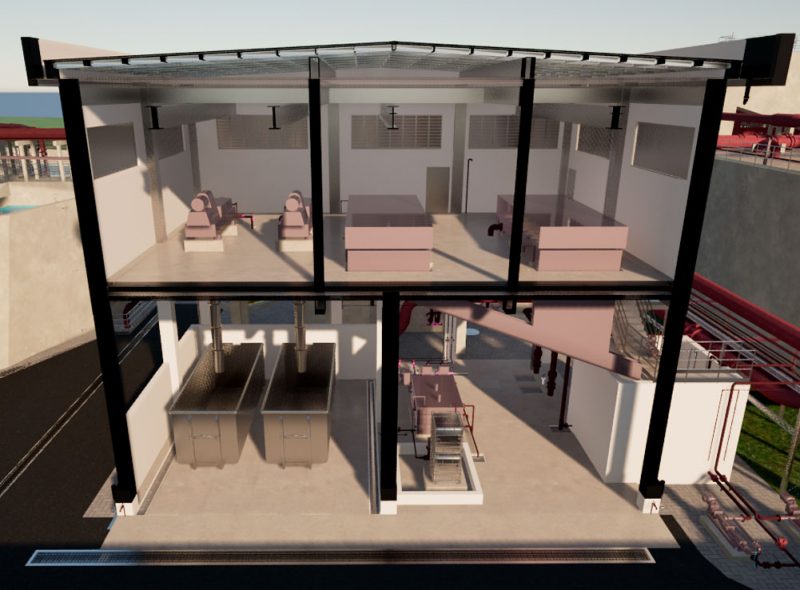 Mechanical Thickening and Dewatering of Sludge
Supporting infrastructure
In addition to the RWPP, the project includes the following associated structures:
- Raw sewage pumping station and raw sewage outfall. This is responsible for transporting part of the domestic effluent from the municipality of Vitória to the RWPP, enabling the diversion of the flow currently directed to the existing treatment plant, which will be decommissioned.
- Equalisation tank. This will be located within the RWPP site, has a usable volume of 9,500 m³, divided into five compartments, and is designed to regulate variations in flow rate and load from the pumping station. The system includes mixers to homogenise the effluent and an odour treatment unit.
- Final effluent lift station. This will be used to pump the concentrate from the reverse osmosis system to the final discharge point. The unit has been sized to handle both the normal operating flow rate of the concentrate and a peak flow rate of 800 l/s, whilst also allowing for operation during emergency bypass situations at the RWPP.
- Final effluent outfall. Constructed from DN 700 high-density polyethylene, approximately 4 km in length, starting from the RWPP, running partly alongside the route of the sewage outfall, and ending at the discharge point into a tributary of the River Santa María.
- Reclaimed water pumping station. This station pumps reclaimed water to industrial consumers. Two pumping units are planned, with capacities of 392 l/s and 90 l/s, intended for use by various users. The unit will be equipped with a comprehensive automation and instrumentation system for the continuous monitoring of the quality of the water produced, enabling the effluent to be automatically returned to the treatment process if the established parameters are not met.
- Reclaimed water supply pipelines. The distribution system comprises two high-density polyethylene pipelines, with diameters of 500 mm and 300 mm, and lengths of approximately 1.8 km and 7.3 km respectively.
The routes are highly complex, passing through industrial areas with a high volume of heavy goods vehicles, as well as various railway crossings, which requires specific construction solutions to ensure operational safety and minimise disruption during implementation.
Final considerations
Work on the RWPP is expected to begin in 2026, with commissioning scheduled for 2027.
This contract represents a milestone for ENGECORPS, as it is the first large-scale project focused on the reuse of treated wastewater, consolidating the company’s position on the national stage in the field of implementing the circular economy in the country.