The rapid growth of the Lima metropolitan area has brought with it significant challenges in terms of mobility, connectivity and urban logistics. Against this backdrop, the Peripheral Ring Road stands as one of the country’s most significant road infrastructure projects, designed to redefine the way people and goods move throughout the city.
A comprehensive solution for urban mobility
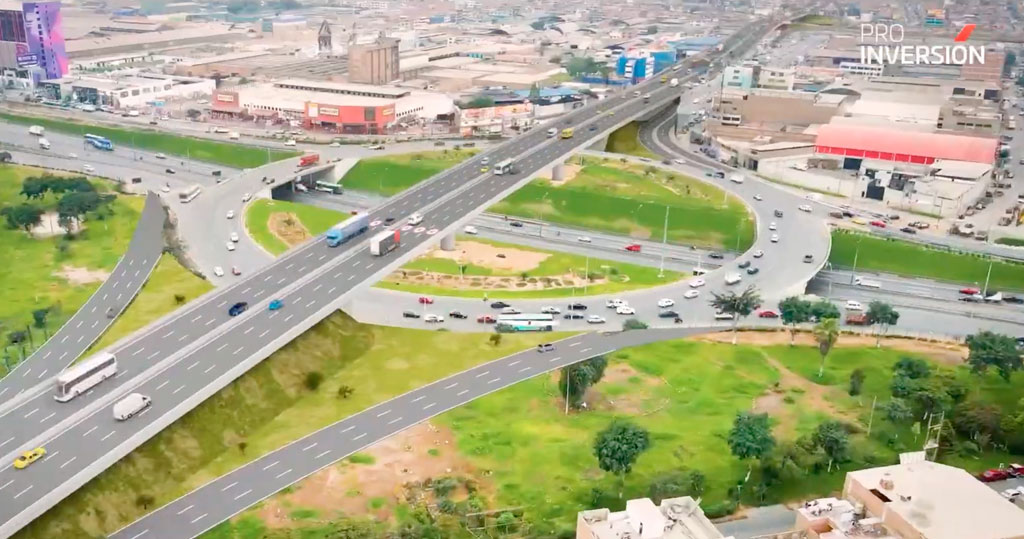
The Peripheral Ring Road is a high-capacity urban motorway that will link the main road networks of Lima and El Callao, facilitating long-distance travel and reducing pressure on local roads. The project includes a multi-lane expressway in each direction, complemented by service roads that will ensure accessibility at district level.
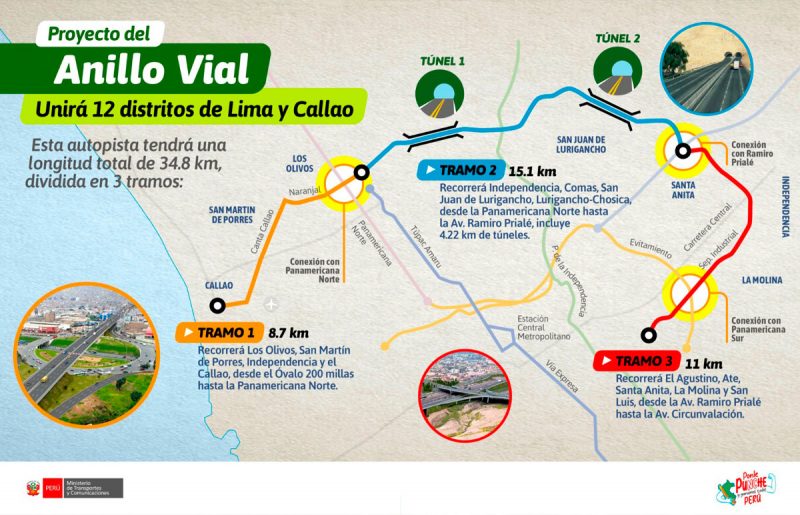 Overview of the Peripheral Ring Road project
This project aims not only to improve journey times but also to optimise the efficiency of the urban transport system, contributing to a more orderly, competitive and sustainable city.
TYPSA’s involvement in the project’s development
TYPSA plays an active role in the development of this strategic infrastructure, leading the Section 1 design and participating in certain components of Section 3.
Section 1: Strategic connectivity from El Callao to North Lima
Section 1 of the Peripheral Ring Road extends for approximately 8.7 km, taking the form of a high-capacity urban motorway with three lanes in each direction on its main carriageway, complemented by service roads for local connectivity.
From a design perspective, a geometry in line with high-performance urban motorway standards has been adopted, with minimum horizontal radii of around 280 m and maximum longitudinal gradients of approximately 5%, ensuring adequate safety and comfort conditions for high operating speeds.
As for the pavement structure, the design envisages a flexible and rigid pavement solution, optimised to meet the demands of heavy traffic and the geotechnical conditions of the corridor, ensuring durability and life-cycle efficiency.
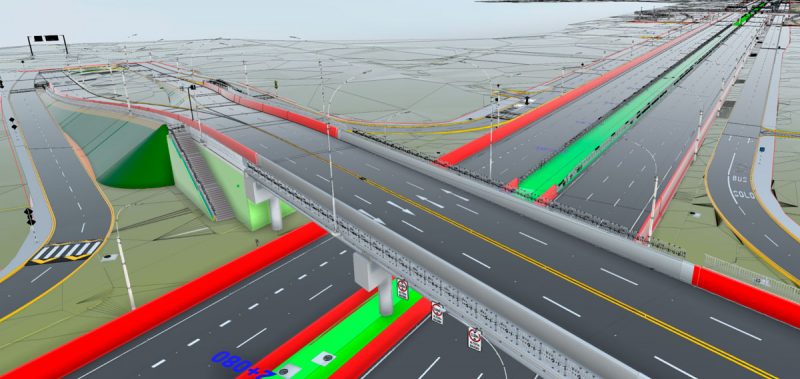 Bertello Bridge
The section includes a significant number of structures, notably 14 mixed-section vehicle bridges, with 1 to 5 spans, whose superstructure consists of prefabricated prestressed concrete beams and a 0.20 m thick reinforced concrete slab. The substructure of the bridges consists of column-pile or column-type piers, with circular-section shafts and a cap beam supporting the superstructure, designed to provide flexibility under dynamic loads. Access to the bridge is provided by reinforced soil walls (RSW) until space conditions allow for the construction of a sloped embankment.
One of the main technical challenges of Section 1 lies in its location within a highly urbanised environment, which requires careful management of interference with existing utility networks and construction planning that minimises disruption to traffic and urban activities. Furthermore, the geotechnical conditions and seismic context of Lima have required a rigorous approach to the design of deep foundations, taking into account soil–structure interaction and the seismic response of columns and abutments.
Taken together, these characteristics reflect a comprehensive design that combines high geometric standards, efficient structural solutions and appropriate adaptation to the urban and geotechnical conditions of the surrounding area.
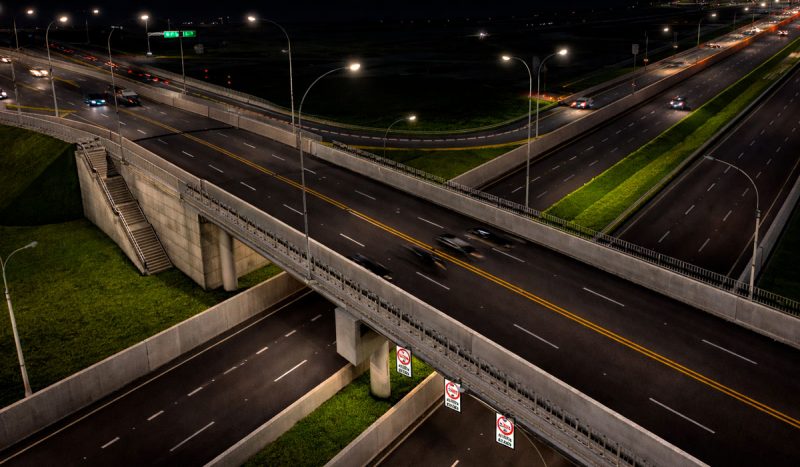 Bertello Bridge
Section 3: Integration with the eastern part of the city
In Section 3, TYPSA’s involvement focuses on the design of certain structures, notably the development of unique bridges that exemplify the application of hybrid solutions to meet highly demanding geometric, structural and operational constraints.
These bridges consist of a continuous three-span deck, with a main span of 120 m, which allows a high-speed railway line to be crossed without intermediate supports, restricting the location of piers to the edges of the track. This condition determined the structural configuration, including the definition of side spans that ensure adequate behaviour under gravitational loads, avoiding negative reactions at the supports.
The superstructure is formed by a variable-camber box girder, a type of structure that optimises the distribution of forces and provides high rigidity and structural efficiency. The deck, 10.10 m wide, accommodates two traffic lanes, side verges and safety barriers, in line with the design standards.
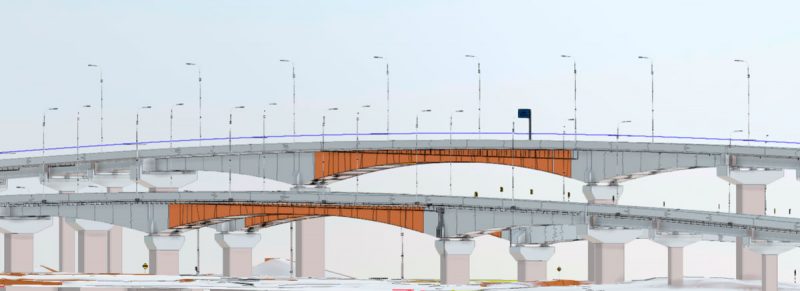 Bypass Road Bridges
In response to the construction constraints associated with high traffic congestion, the main span is constructed using a steel box girder, reducing dead weight and seismic mass, which improves structural performance and facilitates assembly, minimising disruption to traffic. In contrast, the side spans are constructed using post-tensioned concrete, taking advantage of conditions that allow the use of conventional formwork and optimising the solution from both a technical and economic perspective.
The substructure consists of hollow-section reinforced concrete columns and a wall-type abutment, incorporating LRB-type seismic isolation devices that reduce seismic loads through energy dissipation. This approach helps to optimise both the structural design and the foundations.
Taken together, these bridges constitute an efficient and innovative solution that integrates criteria of structural performance, constructability and adaptation to the urban environment, consolidating the use of hybrid systems as an optimal alternative in highly complex infrastructure.
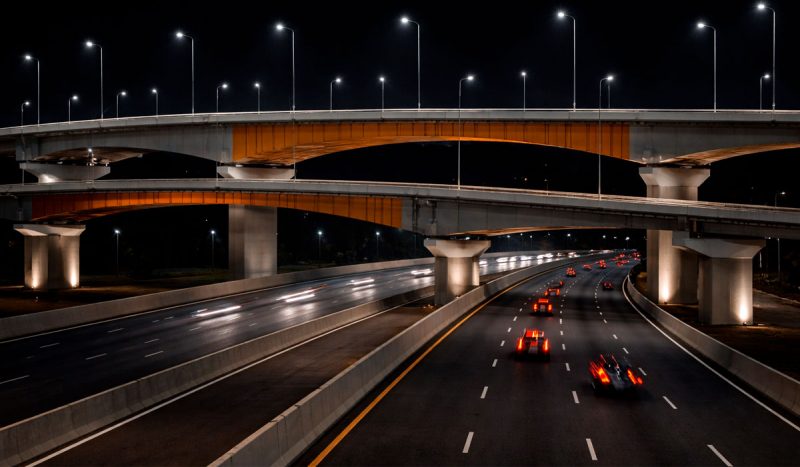 Bypass Road Bridges
Engineering at the service of the city
TYPSA’s involvement in the Peripheral Ring Road represents a significant commitment to the country’s development. Through innovative solutions, a collaborative approach and efficient resource management, TYPSA is helping to bring to fruition an infrastructure that will have a direct impact on the quality of life of millions of citizens.
This project will not only improve urban mobility, but will also boost economic development, facilitate metropolitan logistics and strengthen Lima’s competitiveness as a city.
Commitment to the future
Being part of the Peripheral Ring Road reaffirms our ability to tackle large-scale projects of high technical complexity. We remain committed to developing infrastructure solutions that generate sustainable value and contribute to the orderly growth of our cities.