The Hafeet Rail project, promoted by the transnational company of the same name and comprising Etihad Rail (UAE) and Oman Rail, is the first cross-border rail network between the United Arab Emirates and Oman, connecting the port of Sohar to the UAE’s rail network via a 300 km line, with an investment of $3 billion. Designed to operate at 200 km/h for both passengers and heavy freight, the infrastructure aims to reduce logistics costs by 40% and enhance bilateral connectivity.
The project is divided into five strategic packages ranging from civil engineering works (bridges, tunnels and tracks) and digital control systems (ETCS Level 2) to the procurement of rolling stock (locomotives and freight wagons). Added to these is the development of logistics infrastructure at two key hubs in Oman: the port of Sohar and the border town of Al Buraimi, alongside technical consultancy services to oversee the comprehensive implementation of this cross-border network.
Within this framework, TYPSA, commissioned by the construction consortium comprising the Indian construction firm Larsen & Tubro and China Power Construction, is developing the detailed design for the two aforementioned logistics facilities: the container terminal at the Port of Sohar and the loading and unloading terminal in Al Buraimi.
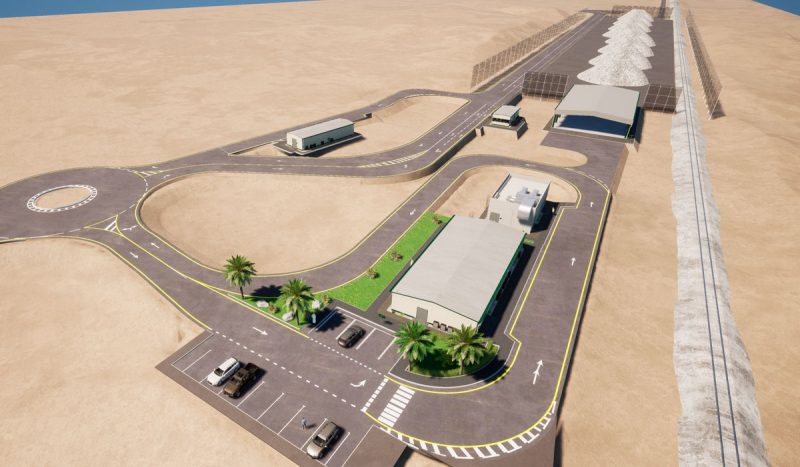
These facilities, each covering an area of 90,000 m², include the railway platform, loading platforms and modal interchange facilities spanning over 300 m, system integration of the logistics terminals with the railway line, development of the terminals, and administrative, technical, warehouse and security buildings, totalling some 4,000 m² of built-up area, and the Al Buraimi passenger station. It also includes the road network that connects the freight platform with the administrative and storage buildings.
Detailed engineering services include an integrated multidisciplinary approach covering geotechnics, surveying, GIS, hydrology, track layout, railway systems and telecommunications, structures, architecture, MEP installations, urban planning and roads. It also includes the preparation of permits, management of approvals, review of workshop drawings and as-built documentation. All of this is developed using BIM methodology up to a level of detail (LOD) of 350.
To carry out this work, TYPSA relies on a coordinated team comprising its head office, management and production teams in India, and local management through its offices in the region. This ensures the application of TYPSA’s extensive global experience in railway systems and civil engineering, alongside knowledge of the region, whilst maximising production efficiency and cost-effectiveness.
The project has been completed and is in its final stages of approval, with an estimated duration of two months. At that point, the construction supervision phase will begin, involving the review of construction drawings and, subsequently, final construction plans. Construction is scheduled to be completed in 2028.