09In 2024, TYPSA won the tender to develop, alongside Quetta Data Centers, its data processing centres on the Iberian Peninsula. The proposal was presented as a framework collaboration agreement for the drafting of the complete architectural and engineering designs for at least three buildings strategically located in the vicinity of the main cities in Spain and Portugal.
This collaborative format is well-suited to the needs of the data centre market, particularly in the private sector. The agreement included the creation of the Quetta brand, incorporating a series of market analyses, technologies, potential clients and possible locations. All of this was done to ensure that the buildings would respond precisely to the demands of a constantly evolving and developing market.
MAD1 Tres Cantos, the project
Based on this technological analysis, TYPSA developed the design for the first building in the municipality of Tres Cantos, near Madrid. The location on Avenida de la Industria ensures the availability of the space and power required for the building, designed in two phases of 10 MW each, to be fully viable. Furthermore, its proximity to the capital offers a competitive advantage to companies requiring low latency (the minimum time taken for data to travel from the data centre to the user).
Cutting-edge design and architecture
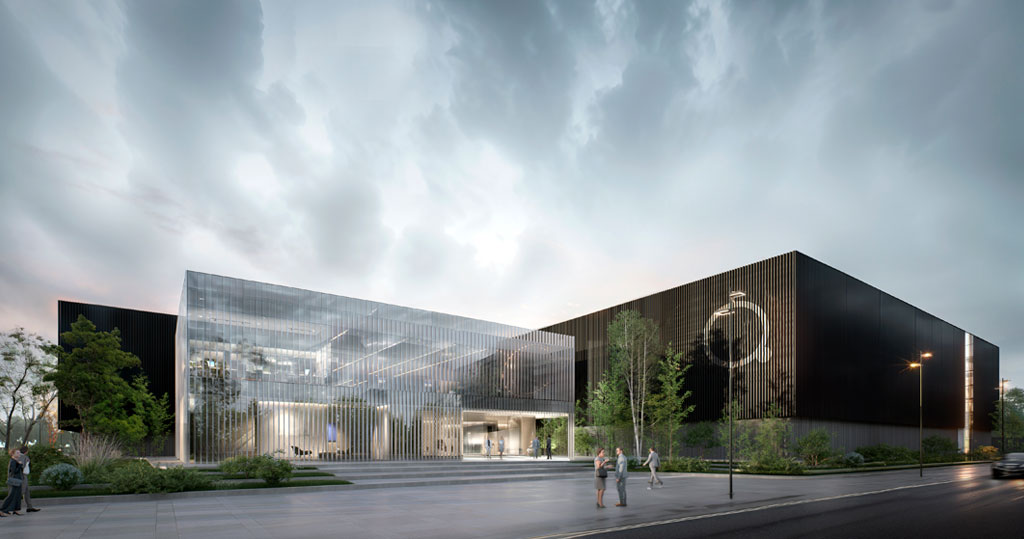
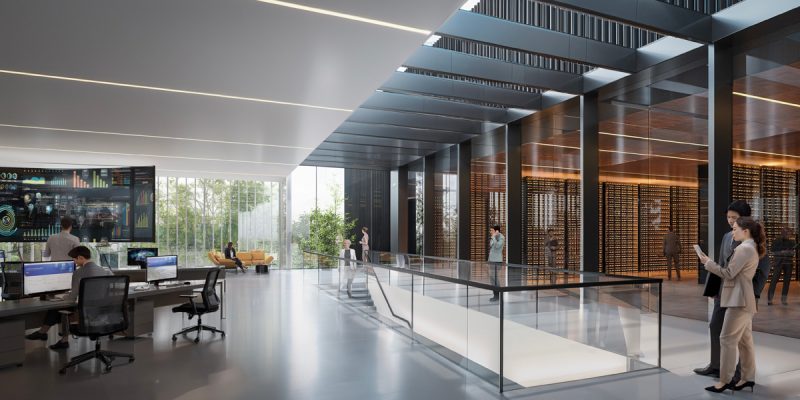
From the outset, Quetta opted for an elegant and contemporary look, moving away from the industrial cliché that often surrounds data centres. TYPSA designed a composition of two separate units for the offices and the data centre itself. The offices are conceived as a light, transparent building, with glass as the predominant material, whilst the technical building, which constitutes the main unit, houses both the data hall and the technical rooms, as well as the electrical and air-conditioning systems. The complex presents a vision of data centres integrated into the city, adding significant value to its immediate surroundings.
Technology and resilience
The Tres Cantos data centre will be TIER 3 certified, which implies a significant level of redundancy in the facilities (N+1), ensuring the power supply to the servers and air conditioning for at least 24 hours in the event of a failure in the main power supply. The final design features a hybrid cooling system, a solution developed by TYPSA to adapt to the increasing power density offered by chips in the data centre market.
Market and future
With this first project for Quetta, TYPSA consolidates its leadership in technological architecture. The company has successfully adapted its long-standing track record to current trends, becoming a key player in the expansion of data centres in Spain.
Various studies indicate that, by 2030, European countries aiming for self-sufficiency in data storage will need to achieve a share of 5–6% of national energy consumption dedicated to critical infrastructure. Currently, in Spain, data centres account for less than 3% of energy consumption, which points to exponential market growth in the coming years.
Against this backdrop, TYPSA has positioned itself as a strategic partner capable of supporting its clients from the conceptualisation of the business model through to final commissioning and, as a result, is undertaking a second project for Quetta in Molins de Rei, Barcelona, known as BCN 1. This new data centre is designed to host edge proximity data storage facilities and will have a total load of 10 MW, a hybrid cooling system and an adjoining office building. As with the previous project, TYPSA is in charge of the design and its construction management.