
The current layout of the Madrid metro network is markedly radial, suffering from a lack of connections between lines as the distance increases from the city centre. Therefore, the need to establish connections between lines becomes more pressing as we move away from the centre, especially in the eastern part of the network. This problem particularly affects line 5, which stops just short of connecting with Adolfo Suárez Madrid-Barajas airport.
The extension of line 5 from Alameda de Osuna station to Aeropuerto T1-T2-T3 station provides a solution to this problem, improving connectivity between the city centre and the aforementioned airport terminals, linking at this point with line 8, which in turn connects to T4, through an extension and renovation of the station that will connect both lines.
This project will benefit almost 62 million people who use the airport each year and, above all, more than 40,000 people who work there. The works are being financed by the European Commission through the allocation of ERDF funds under the Community of Madrid Programme 2021-2027 and will take a total of 38 months to complete.
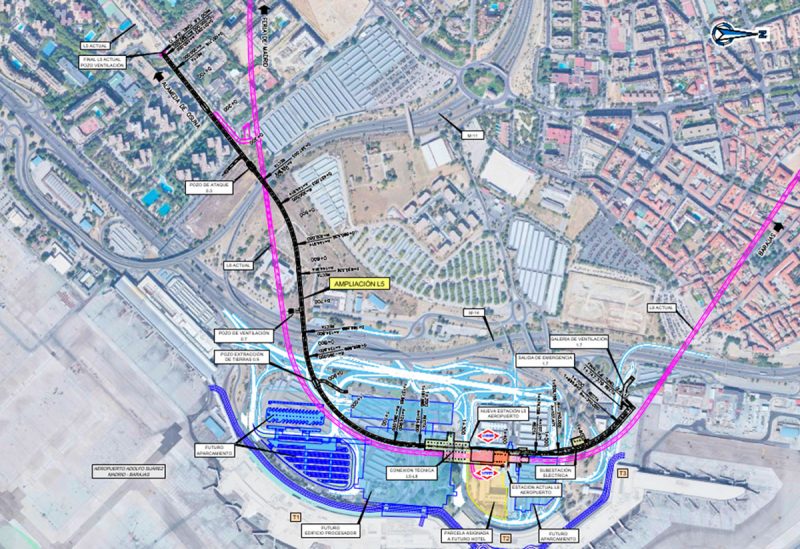 Overall plan for the extension of line 5 to Adolfo Suárez Madrid-Barajas airport. (Source: Department of Housing, Transport and Infrastructure. Community of Madrid.)
Since May 2025, TYPSA, together with another associated consultancy firm, has been providing construction management and health and safety coordination services for this project, on behalf of the Directorate-General for Public Transport Infrastructure of the Regional Ministry of Housing, Transport and Infrastructure of the Community of Madrid. The team consists of the construction manager, execution manager, health and safety coordinator, facilities technician, construction management support technician and BIM manager.
The project involves the construction of a 1,747 metre tunnel, of which 683 metres will be excavated using the traditional Madrid method, and the remaining 1,064 metres will be constructed between screens with a covered slab, including the station connecting with line 8. The tunnel, which will have five access points and three simultaneous working faces, will include two emergency exits, a ventilation shaft and a pumping shaft.
The contract also includes the installation of a double electrified track and a four-track train depot at the end of line 5, with capacity for four trains, as well as the safety, signalling and communications facilities for the commissioning of the line.
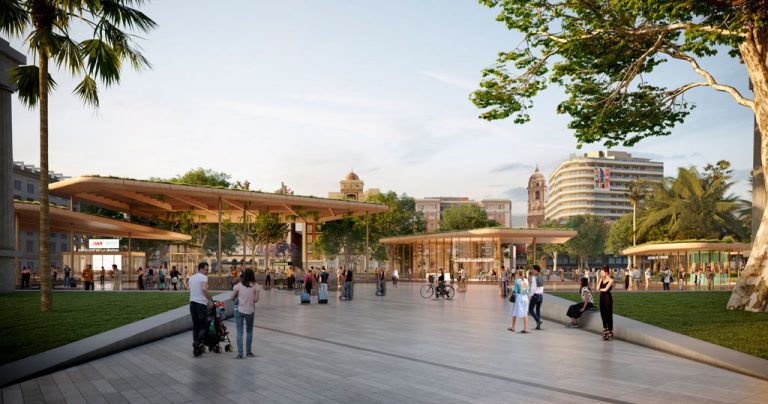
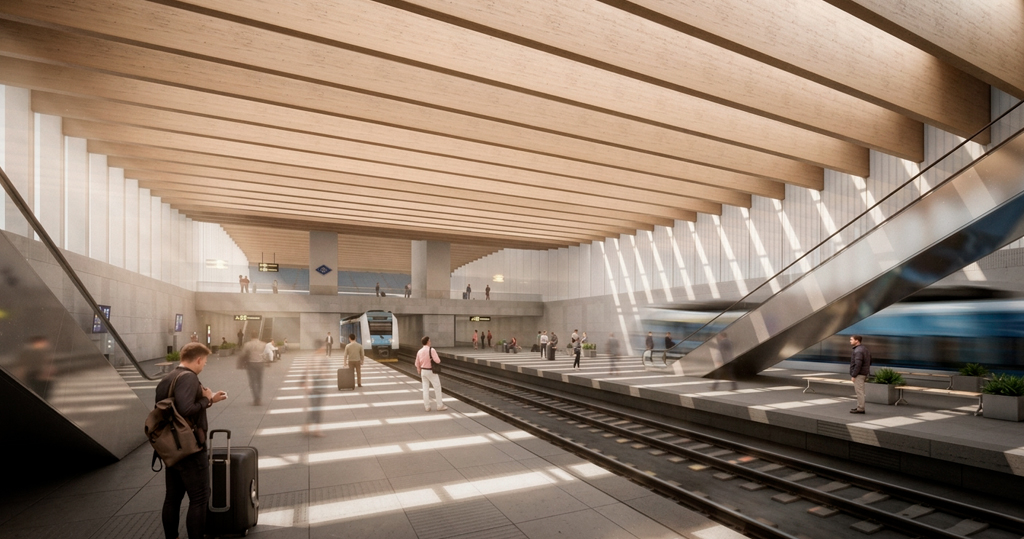
The renovation of the Airport T1-T2-T3 station will be visible through an extensive glass roof that will rise above the central area of the station. This element gives it an elegance in keeping with its important functional and spatial role as a welcoming setting for visitors arriving in Madrid, as it is intended to be the atrium or prelude to the city, offering a friendly and warm experience to users through the presence of natural light and the transparency provided by the sloping glass panels.
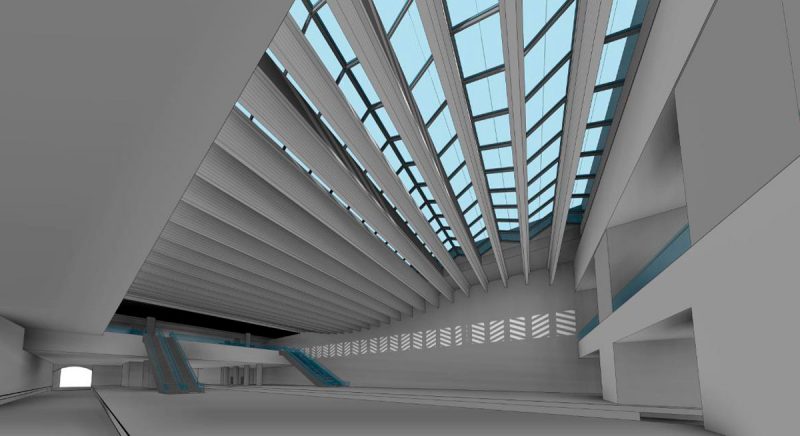 3D image of the future station
This transparency, in turn, serves as a guide for visitors, who will be able to see the surrounding airport buildings from inside and, ultimately, the future Terminal Building.
Measuring 30.40 x 53.30 m, the roof comprises a glazed surface area of 1,620m² located above the large central area of the station, with a volume of 19,325 m3 , interrupted only by the 47.50 m long suspended walkway connecting the two lobbies on either side. These figures reflect the magnitude of the proposed operation.
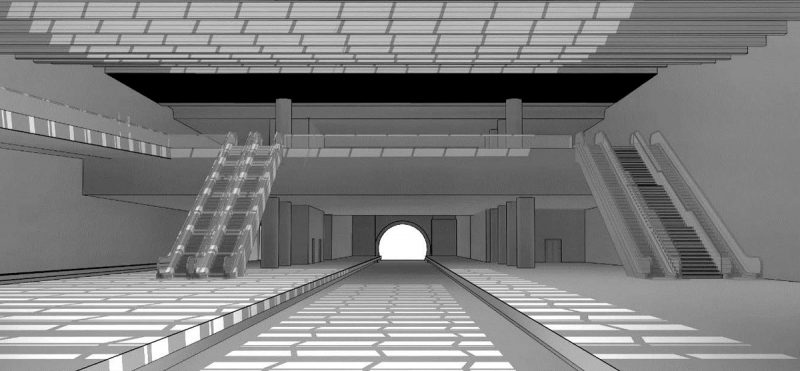 3D images of the future station
The work is being carried out in 14 phases to minimise the impact on traffic, car parks, affected services and airport operations.
The most significant work carried out to date has been:
- Creation of auxiliary facility areas (ZIAS) 1 and 2.
- Assembly of the site offices.
- Relocation of the petrol station to allow work on the new station to begin.
- Excavation of the tunnel access shafts.
- Construction of screens for false tunnel 1, false tunnel 2, ventilation shaft 0+700 and start of screen construction in the station area.
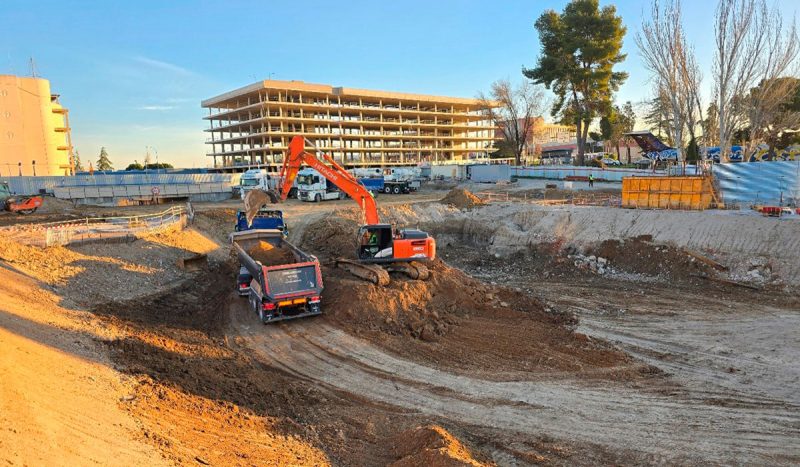 Excavation of trench for the construction of screens in the station area
Weekly coordination meetings are held with representatives from the Community of Madrid, the project management team, the contractor and Metro de Madrid, to discuss the progress and monitoring of the work carried out during the current week, and the forecast for the following week.
Document management for the project is carried out through TYPSA’s SharePoint, where the vast amount of documentation generated by the project is uploaded and organised.
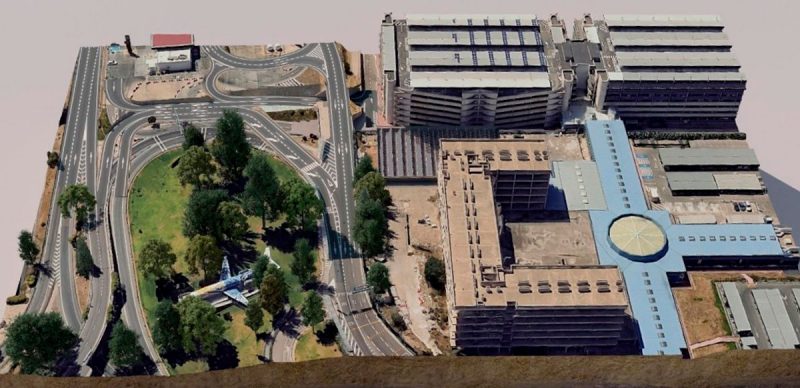 3D image of the final state of the last phase of construction in the station area