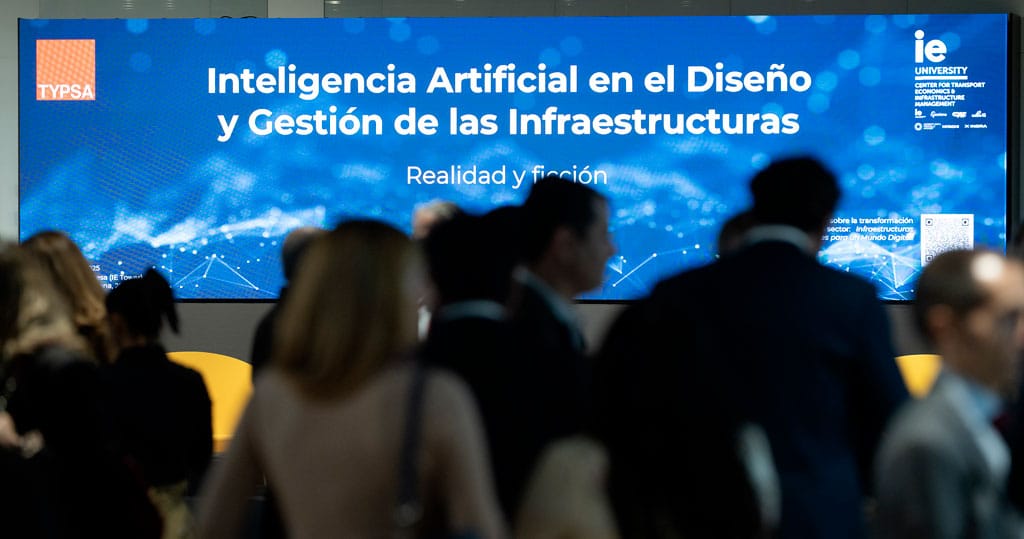
On 13 November 2025, TYPSA organised a conference at the IE Tower in Madrid which brought together representatives from the government, universities, construction companies, concessionaires and technology firms under the title Artificial intelligence in infrastructure design and management: reality and fiction. The event served as a platform to present the document Smart Infrastructure for a Digital World, which sets out TYPSA’s vision of how data, digitalisation, and artificial intelligence (AI) are transforming the sector.
The session was opened by Mr. Julio Gómez-Pomar, president of the IE Centre for Transport Economics & Infrastructure Management at IE University, who highlighted the role of IE as a forum for reflection and dissemination of ideas on mobility and infrastructure. His speech set the tone for the conference: the infrastructure sector, despite being traditional, is staking much of its immediate future on its ability to understand, adopt and scale technologies such as AI.
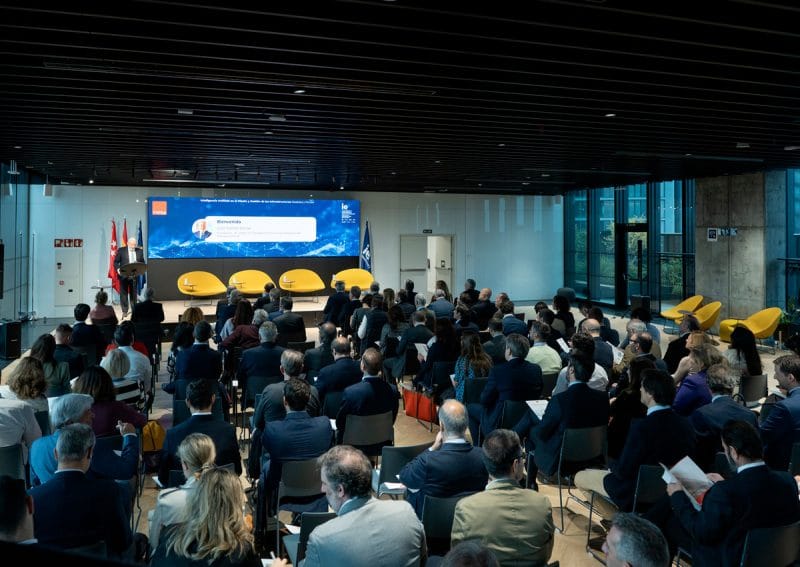
The opening speech was given by Mr. Juan Pedro Fernández Palomino, Director General for Roads, at the Ministry of Transport, Mobility and Urban Agenda, who described AI as a paradigm shift that will transform the entire infrastructure life cycle. He outlined specific initiatives being implemented by the ministry, including the mandatory incorporation of AI-powered computer vision systems into road maintenance procurement documents and the systematic use of mobility big data for planning purposes. He placed particular emphasis on the Sustainable Mobility Law, currently in the legislative process, as the regulatory framework structuring this transformation.
The panel discussion featured three leading voices with complementary perspectives: Julian Núñez, president of SEOPAN; Carme Artigas, senior fellow at Harvard’s Belfer Center and vice-president of the United Nations AI Advisory Council; and Carlos Martínez Miguel, global director of AI and Data at Telefónica Tech. The debate, moderated by José Cordovilla, director of Strategic Consulting at TYPSA, addressed critical issues such as the battle for control of industrial data, the mixed ecosystem between large companies and specialised start-ups, the need to modernise public procurement regulatory frameworks, and Europe’s strategic role in applied AI in the race for supermodels.
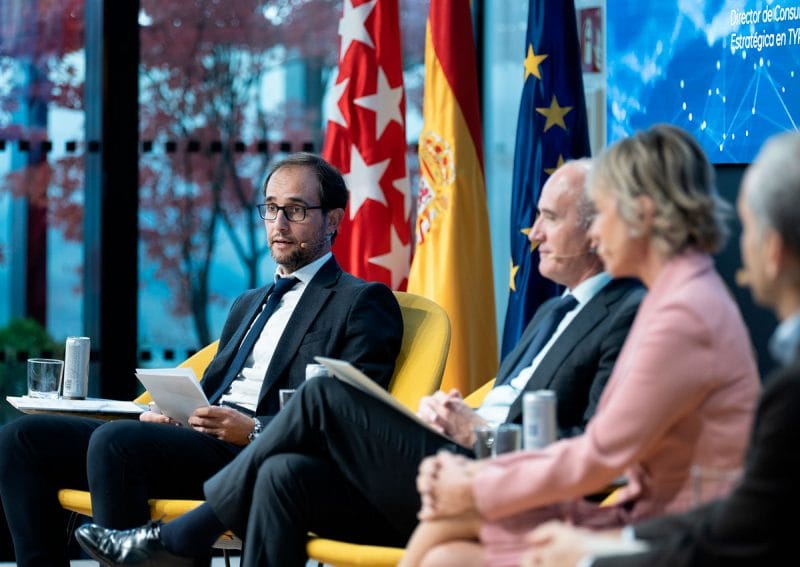
The debate pointed out that the battle for AI today is the battle for control of industrial data, and highlighted the importance of Europe positioning itself as the safest and most reliable environment for the adoption of AI in industrial sectors. The need to modernise public procurement frameworks was also identified to ensure that quality engineering and construction are properly valued, and innovation has real room to scale.
The document presented, led and coordinated by TYPSA’s Strategic Consulting division, shares the knowledge of professionals from different areas of the Group and explores how emerging technologies such as the Internet of Things (IoT), artificial intelligence, building information modelling (BIM), digital twins and asset management systems are changing the rules of the game in the sector. Rather than a question of improving efficiency or reducing costs, it is more about creating safer, more sustainable and people-centred infrastructure.
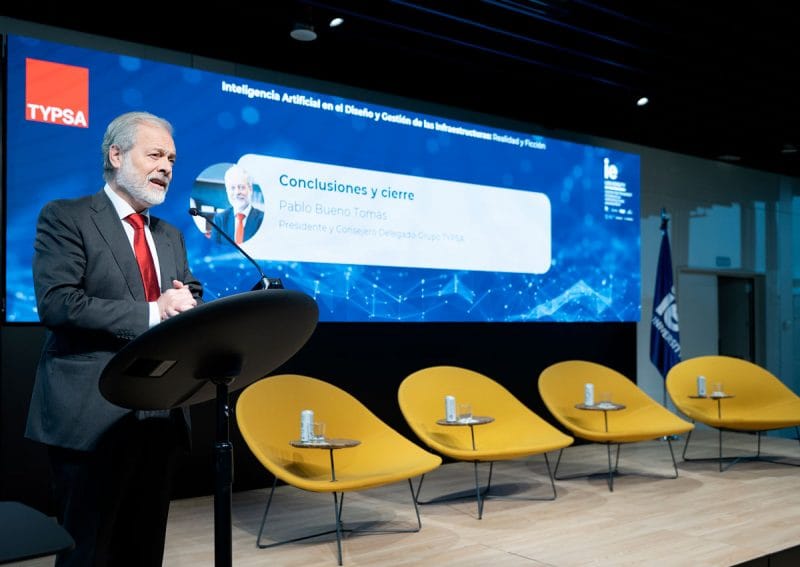
Pablo Bueno, President and CEO of TYPSA, closed the conference by highlighting three fundamental lessons: alliances between technology companies, engineering firms and government are the model of the future; the challenge of scaling up is not technological, but structural; and data must be managed with the same responsibility with which we manage a viaduct or a dam. His final message summarised the philosophy that should guide this transformation: “Artificial intelligence is not about machines, but about how we use the technology to better serve society.”
This conference is part of TYPSA’s commitment to knowledge leadership and best practices in the field of infrastructure, and reaffirms the company’s ability to lead high-level debates contributing to the advancement of the sector.
TYPSA’s report Smart Infrastructure for a Digital World can be downloaded at this link and serves as a reference for all stakeholders involved in the digital transformation of the sector. The conference was organised in collaboration with IE University’s Centre for Transport Economics and Infrastructure Management.