In north-western Saudi Arabia, in the extraordinary region of AlUla, where the desert landscape intertwines with a millennia-old historical legacy, one of the country’s most ambitious sports developments is taking shape: the AlUla High Performance Centre & Sports Club. More than just a sports complex, the project is conceived as a new-generation territorial infrastructure, capable of integrating landscape, city and economic activity within an environment of immense cultural and environmental value. Its development is directly aligned with the strategic objectives of the Kingdom of Saudi Arabia, both within the framework of Vision 2030 and in the preparation of infrastructure linked to the 2034 FIFA World Cup, forming part of the initiatives promoted by the Royal Commission for AlUla (RCU) and supported at the highest institutional level by HRH Mohammed Bin Salman.
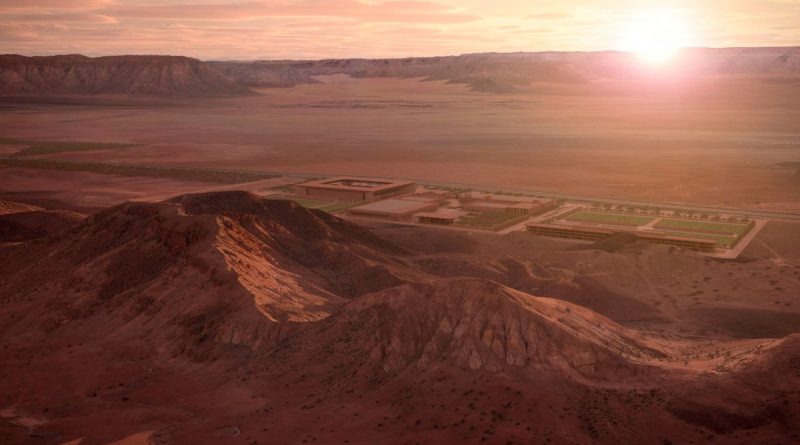
Its location responds to a strategic position within the region, just 15 minutes from AlUla International Airport, on the city’s southern growth axis and connected to a regional-scale recreational corridor. This location not only guarantees accessibility and visibility but also positions the complex as a structuring element within AlUla’s urban and landscape system, reinforcing its role as a key infrastructure in the organisation of the region.
In this context, the project cannot be understood solely as a sports facility, but as a fundamental component of a broader strategy for regional transformation, in which AlUla positions itself as a global destination combining heritage, tourism, culture and sport. The commitment to developing high-performance infrastructure stems from the desire to attract international talent, generate economic activity and consolidate a new identity for the region, in which sport becomes a driver of development and global visibility.
The complex is being developed on a plot of approximately 50 hectares, with a built area of around 190,000 m² and an estimated investment of around 3 billion Saudi riyals. These figures reflect the ambition of a project designed to operate on multiple scales: as a high-performance centre, as urban infrastructure and as a liveable landscape. The complex has been designed as an official facility capable of simultaneously hosting two international teams during the 2034 World Cup, meeting FIFA’s most stringent standards and establishing itself as one of the world’s leading training centres.
The project has been developed by the architectural firm Fenwick Iribarren Architects (FIA), with TYPSA participating as a strategic partner in the comprehensive development of the engineering. This collaboration is structured around a deeply integrated working model, in which architecture and engineering evolve simultaneously from the initial phases. The structure, MEP installations, civil engineering, geotechnics, hydraulics and sustainability are not incorporated as added layers, but as constituent elements of the project. In this sense, engineering ceases to be a supporting element and becomes a true driving force behind the project, capable of transforming technical constraints into spatial and environmental opportunities.
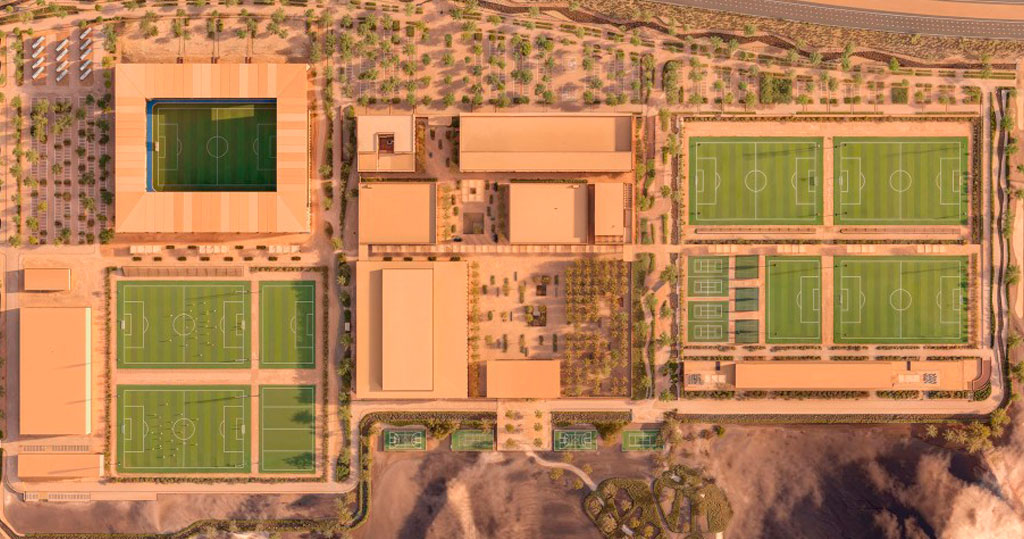
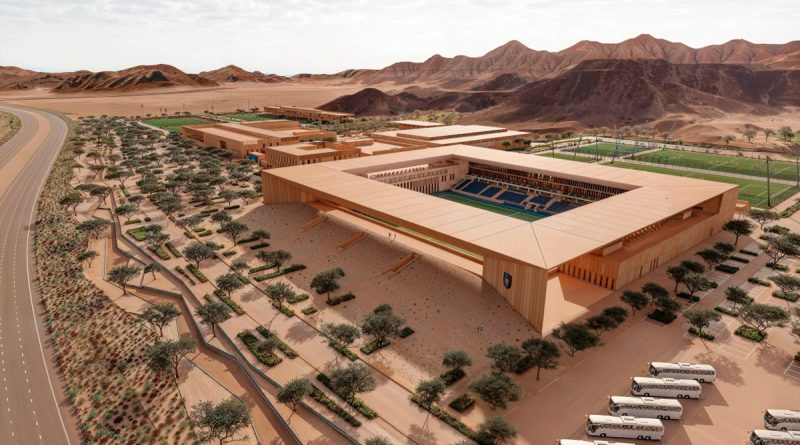
The complex is configured as a complete sports ecosystem, where each element responds to a logic of high performance and functional complementarity. The main feature is the Outdoor Arena or mini-stadium, with a capacity for 5,000 spectators, conceived as an iconic element in the complex’s profile and as a symbolic gateway to the complex from the airport arrival area. Its position in the most public area of the master plan makes it the main visible landmark and the point of connection between the club, the community and international visitors. Of particular note is the entrance span with a 120-metre-wide portico, designed to be light and slender.
Surrounding it is a system of outdoor training pitches, certified by FIFA, which allow teams to train simultaneously under top-level conditions, combining operational efficiency and privacy. This system is complemented by an indoor football pavilion of approximately 13,000 m² and two multi-sports halls that ensure the continuity of activities in controlled conditions, responding to the climatic demands of the environment.
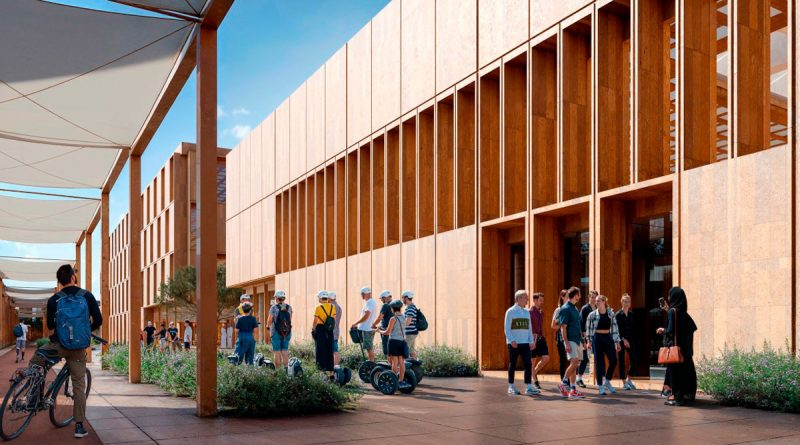
The functional core of the project is centred on the Heart of the City square, around which the main buildings are arranged. The High Performance Centre, with a surface area of nearly 19,000 m², incorporates spaces for physical training, performance analysis, recovery, physiotherapy and medical care, alongside training and research areas. Surrounding it are the academy, the club offices and an athletes’ residence of approximately 12,300 m² with capacity for 150 rooms. This complex forms a self-sufficient and self- environment that transcends the concept of a sports facility to become a genuine small city, an urban environment in which training, daily life and sports are integrated into a continuous fabric, linked by squares, promenades, meeting spaces and areas for controlled interaction. It is not merely a sports centre, but a part of the city.
One of the most significant aspects of the project is its relationship with the landscape, which becomes the true conceptual origin of the design. The master plan takes the existing wadi system as its starting point, elevating it to the status of the project’s founding idea. The wadi ceases to be a mere hydraulic infrastructure and becomes the backbone of the complex: a linear park that functions simultaneously as an ecological system, a drainage infrastructure, a pedestrian mobility network and a cultural element that evokes the memory of the valley. This active landscape links the various programmes, channels runoff and creates a spatial continuity that integrates nature, public space and infrastructure.
The extension of the wadi forms part of a public space strategy that connects the complex with AlUla’s urban fabric, forming part of a recreational corridor that shapes the city’s southern expansion. This linear park incorporates footpaths, cycle lanes and recreational areas, transforming a hydraulic necessity into a landscape and urban opportunity. Water engineering thus becomes a design tool capable of generating identity and added value.
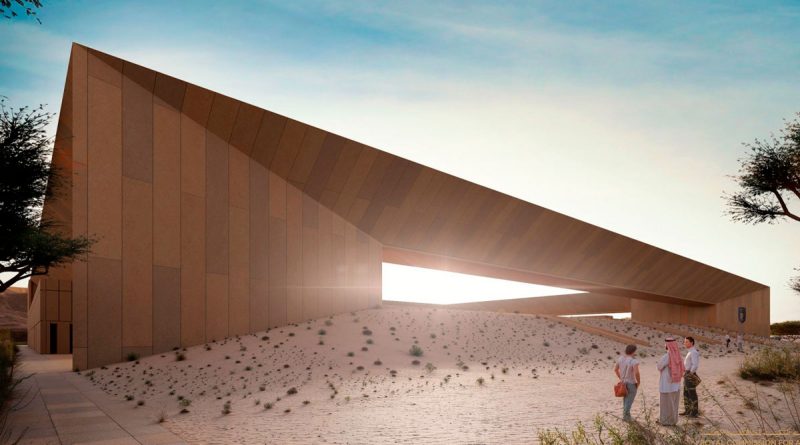
The architectural layout follows a principle of minimal intervention, with carefully fragmented low-rise buildings that preserve views of the mountains and maintain a clean, continuous skyline. The architecture does not compete with the landscape, but rather frames it, creating a direct relationship with the natural formations. The complex is perceived as a “shaded village emerging from the terrain”, where courtyards, pergolas, sheltered walkways and intermediate spaces form a climate-adapted system deeply linked to the local culture.
This integration is particularly evident in the arrival experience. From the airport, the complex appears as a porous and contained architectural form, organised around the revitalised wadi, where landscape, architecture and culture merge into a unified image that avoids iconic gestures and embraces an identity rooted in the place.
The functional organisation of the complex is based on a clear separation of flows, allowing public activity to be reconciled with the demands of high performance. The upper platform is conceived as a continuous pedestrian space that links the various uses, whilst a lower level houses vehicular circulation, technical access points and services. This strategy conceals the operational complexity, ensuring a clean, efficient and controlled spatial experience.
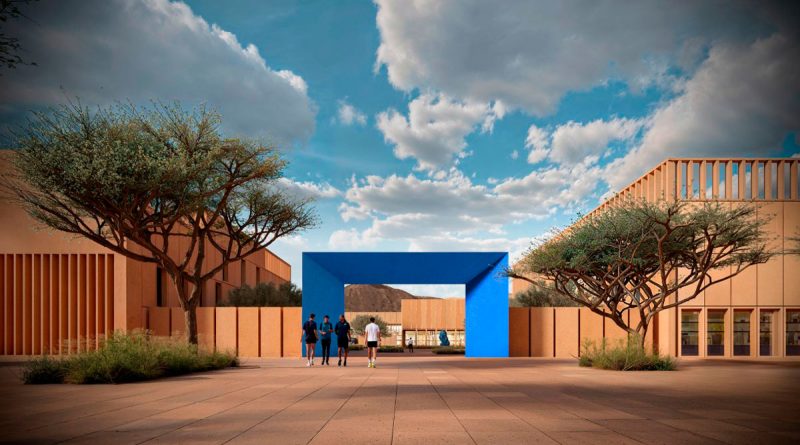
Sustainability is approached as a transversal principle, with the aim of achieving LEED Gold certification. Passive strategies such as orientation, shade generation and the creation of microclimates are combined with high-efficiency active systems and advanced water management, in which the landscape and infrastructure function in an integrated manner.
The complexity of the project has required the implementation of BIM methodologies as a coordination tool, enabling the integration of disciplines, the optimisation of solutions and the assurance of design consistency throughout all phases.
The AlUla High Performance Centre & Sports Club thus represents a new generation of sports infrastructure, in which architecture, engineering and landscape are integrated into a single system. Beyond its physical dimensions, the project constitutes a strategic initiative capable of generating activity, attracting talent and consolidating a new sporting culture in the region. In this context, TYPSA’s involvement is crucial, providing a holistic vision that places engineering at the heart of the creative process and demonstrates how its integration with architecture enables the creation of solutions capable of transcending the conventional and looking towards the future.