
Continuing the work carried out on the Eglinton Crosstown West Extension
The Yonge Subway Extension, north of Toronto (YNSE) is one of the most significant investments in the region’s mobility plan. Line 1 will be extended to new urban developments and will improve accessibility, reduce congestion and respond to sustained population growth. This project is part of the same metropolitan expansion programme in which TYPSA participated with great success in the Eglinton Crosstown West Extension (ECWE) project, an experience that provides a solid technical foundation for now tackling the challenges of extending this section.
A key project within the Toronto network
The Yonge corridor is the most used north-south route in the system managed by the Toronto Transit Commission (TTC). The extension to the north will:
- strengthen connectivity with expanding areas, providing access to more than 26,000 residents living near the new stations.
- reduce travel times downtown. An estimated 22,900 people who work downtown live within walking distance of the stations.
- increase the overall capacity of the network, with more than 94,000 additional passengers per day.
- improve operational resilience in the face of future growth.
- reduce the usual congestion on this north-south route, with an estimated reduction of more than 7,700 vehicles/km during the morning rush hour. The result will be a reduction in annual greenhouse gas emissions of more than 4,800 tonnes.
The complexity of the environment, which is dense, urbanised, and highly conditioned by existing services, requires precise technical solutions and exhaustive coordination between teams.
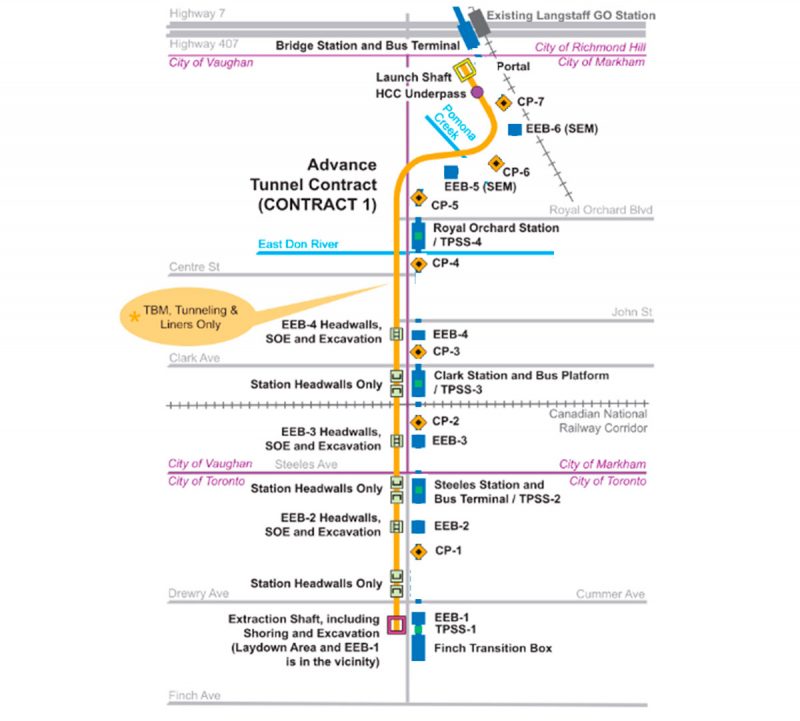 Schematic view of the Yonge North Subway Extension route
Tendering process
As in the case of the westward extension of the ECWE, the end client (Metrolinx and Infrastructure Ontario) has packaged the work in a way that, while unusual in other international markets, is already familiar to the TYPSA team. The main civil works package is the Advance Tunnel Contract, which includes the construction of the tunnels, the launch and extraction shafts for the tunnel boring machines, the end walls of the future stations, one of the emergency exit buildings and, in this case, the design, but not the construction, of the communication galleries between the two tubes.
As this is a design-build-finance tender, the team that so successfully completed the ECWE design-build decided to join forces once again. The construction joint venture formed by Dragados-Aecon-Ghella chose to call itself North End Connectors for this new contract, once again relying on the engineering joint venture formed by TYPSA and EXP, this time under the leadership of TYPSA and with the participation of Pedelta as a subcontractor for the design of the launch shaft. It should be noted that the ECWE project was selected as Best Project of the Year 2025 by the Tunnel Association of Canada (TAC). In the final phase of the tender process, Dragados was replaced by FCC, which took over the leadership of the construction joint venture.
Our team developed a solution for the tunnel boring machine launch area that significantly reduced the technical and time risks compared to the reference design solution developed by the client. The significant reduction in the risk profile and the limited impact on third parties (in particular Canadian National Railway, CN Rail) was recognised by the end client as one of the main reasons why our team was selected as the winner, thus beginning the development of the detailed design phase.
The scope of TYPSA’s work on the Yonge corridor
TYPSA is responsible for the design and analysis of various underground elements of particular relevance:
- Tunnels constructed using tunnel boring machines (TBMs) and sequential excavation methods (SEM), including not only connecting galleries but also two emergency exits excavated in the mine along with their ramps and galleries.
- Subsidence analysis along the entire route.
- Technical management and BIM.
This approach combines tunnel engineering, geotechnics, structures and BIM, providing technical robustness and multidisciplinary capabilities.
Where we work from: a team distributed between Canada, Spain and the United States.
The project is being developed through an international collaboration model:
- Canada (Toronto): direct relationship with the contractor and continuous review of construction solutions, dialogue with Metrolinx, EXP and Pedelta, and agile response to new construction constraints. Canada also leads the subsidence analysis.
- Spain (Madrid and Barcelona): structural design of tunnels and shafts, advanced geotechnical calculations and BIM coordination, carried out by teams specialising in underground works.
- USA: leadership in TBM tunnel design, in coordination with the production team in Spain.
This integration allows us to combine local presence with global technical capacity, which is one of TYPSA’s hallmarks.
Technical challenges of the project
The extension of the Yonge North line presents particular challenges that differentiate its design from other recent projects:
- Variable geology: combination of soils and weathered rock, with high water tables.
- Dense urban environment: need to control settlement and impact on sensitive infrastructure. Much of the route runs under Yonge St., one of Toronto’s main avenues.
- High contractual demands, with strict requirements regarding third-party impacts, impact limitation, design of temporary excavation support structures (SOE), etc.
- Coexistence with multiple stakeholders requiring continuous coordination, harmonised technical criteria and highly complex management of contractual requirements.
These constraints have required highly refined construction solutions, with intensive use of three-dimensional models, non-linear analyses and high-level soil-structure interaction assessments.
One of the main technical challenges was the location of the tunnel boring machine launch site. Various constraints on the route imposed in previous phases, such as the location of an existing station to the north and the prohibition of the route running through a nearby cemetery, meant that the launch shaft had to be located in an area with high groundwater levels, low ground conditions and the railway tracks of CN Rail, the country’s main freight transport network, next to the pile screens of the shaft. The TYPSA technical team considered that the solution proposed in the Reference Project had shortcomings that generated an unacceptable risk profile and also would also have a significant impact on the construction schedule. The solution proposed by TYPSA for the shallow launch of the tunnel boring machine was, as already indicated, key to the award.
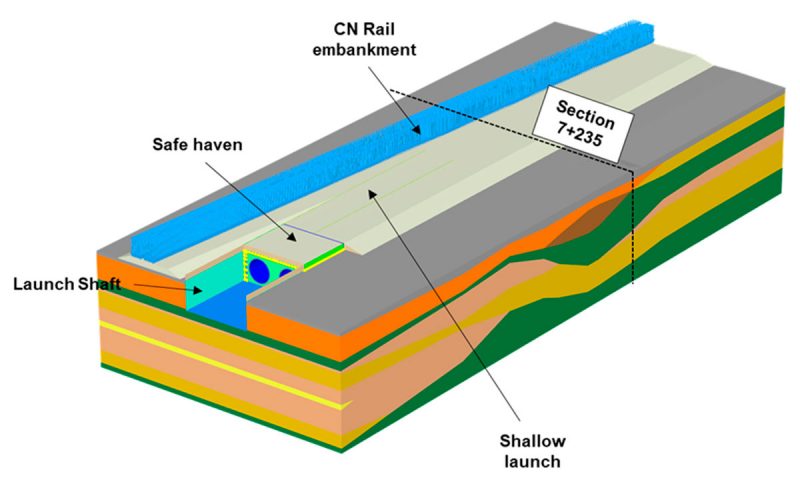 Three-dimensional model of the shaft and launch in low ground conditions
Another significant technical constraint was the geotechnical conditions in the soil-rock transition zone, coinciding with the point where the route runs at greater depth with a high water table. After intense technical debate, it was concluded that it would be advisable to use TBMs capable of working with a shield of pressure from soil and slurry. This decision was recognised by the client as another key factor in the award of the contract. The use of these machines is also an additional resource for reducing the risk in the surface section where pressure excavation is planned to begin.
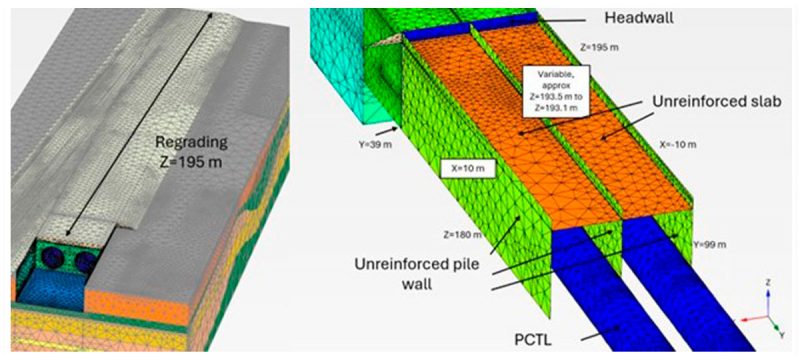 Finite element model of the solution for the shallow launch
Current status of the project and next steps
The Yonge North Advance Tunnel Contract (ATYNSE) project is progressing at a good pace. The design is at an advanced stage, while work on the launch shaft has already begun so that the box excavation can be ready to receive the tunnel boring machines when their manufacture is complete.
The main challenges facing the team are not so much technical in nature, as the team with its wealth of experience can tackle them with confidence, but rather relate to the management of third parties (stakeholders) and the approval process by the end client.
The experience gained in the Eglinton project has helped to understand the complex approval processes for deliverables in contracts with Metrolinx and Infrastructure Ontario, but each review process involves multiple meetings in which each comment is reviewed in detail. This requires a great deal of patience from the project drafting team, explaining every decision taken down to the last detail.
The end client’s confidence in both TYPSA and the construction team has been demonstrated by the client’s decision to launch a collaborative design process for the Steeles and Clark station boxes, as well as the Royal Orchard cavern, directly involving our team without a prior tender. This would have been the second design package to be put out to tender for the design and construction work, however the client has chosen to speed up the process by awarding the design directly to our team. This will be the subject of a new article in the future.
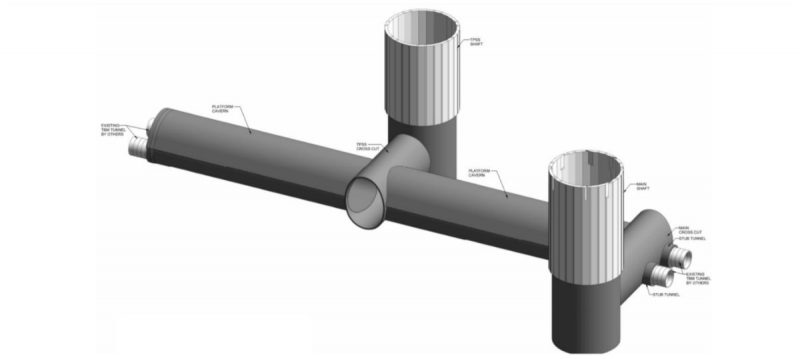 Royal Orchard Station cavern and its shafts
A strategic project that consolidates TYPSA’s presence in Canada
The Yonge North extension project is not just a design contract: it is confirmation of TYPSA’s growing role in the Canadian infrastructure market. The combination of technical expertise, international solvency and the ability to accompany the client throughout the life of the project is already a recognised benchmark in Canada and broadens our recognition in North America in general.
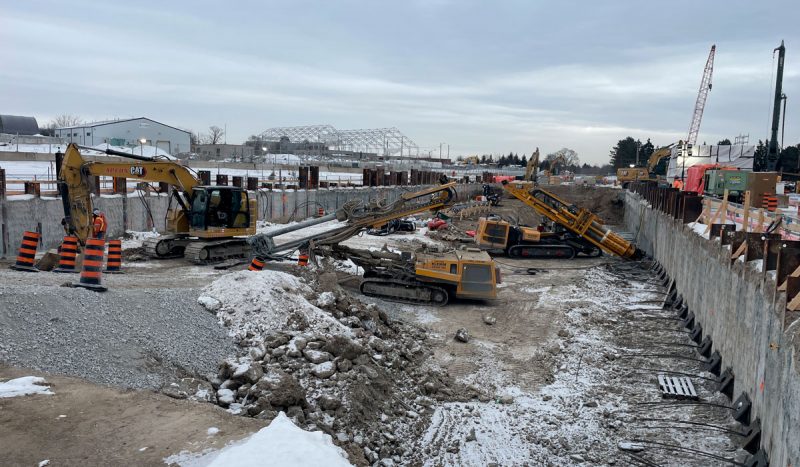 Launch shaft – February 2026