TYPSA, sommissioned by Adif, is overseeing the construction of the viaduct over the Ebro River and the connecting platform with the Castejón-Pamplona Region high-speed railway. This is a high-speed stretch of the Cantabrian-Mediterranean corridor, where the Ebro River crosses between Zaragoza and Pamplona.
This is a UIC standard gauge line, with mixed passenger and freight traffic and a maximum speed of 350 km/h. The section comprises the whole length of the viaduct itself, 700 m in total, and one of the two transition wedges, so it can be said that it is a purely structural project.
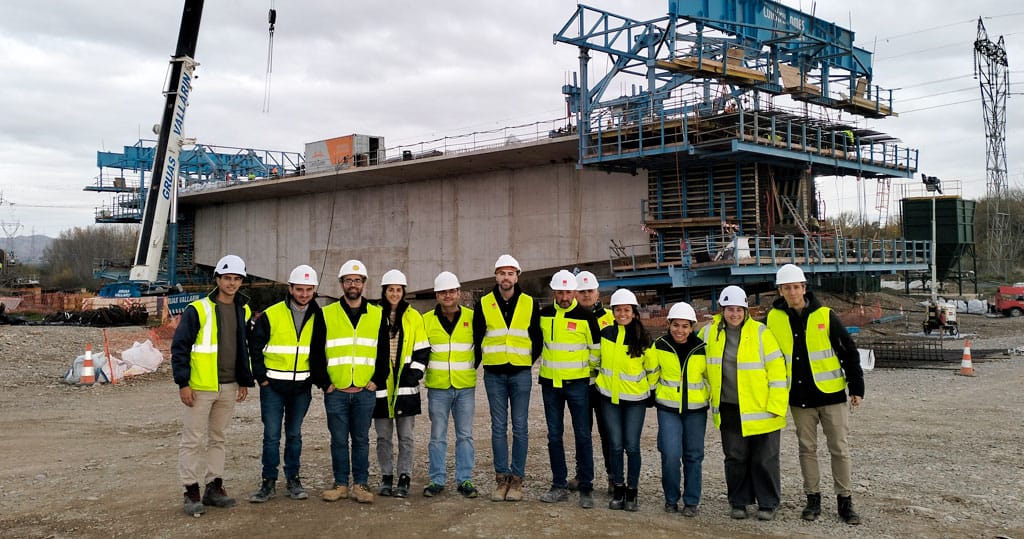
In November 2025, several colleagues from the structural departments of Euskadi, Intemac and Madrid had the opportunity to visit this unique work, in which TYPSA is actively involved.
As part of the services, TYPSA is carrying out the revision of the design contained in the current modified project, providing technical advice on the specific incidents that occur during construction, the surveillance of the pits on the construction site, topographic control, the assurance of material quality, the economic and time monitoring of the work and the collaboration in the development of the definitive BIM model.
The viaduct has a distribution of spans of 41.00 + 6 x 51.25 + 66.50 + 2 x 112.50 + 60.00 m and is continuous throughout its length. On the one hand, the 41.00 m and 51.25 m spans are being executed in stages using post-tensioned concrete with the use of an overhead self-launching movable scaffolding system, while the longer spans, which cross the Ebro River, are being executed using successive cantilever construction, also involving sections with the same material. The depth is constant at 3.70 m in the scaffolding section, and varies between 4.50 m at the centre of the span and 8.50 m over the piers in the cantilever section. The deck width is 14 m, as is common on high-speed rail lines with a dual-direction traffic. The cross-section consists of a single box girder with two lateral cantilevers each of 4.25 m, and the webs are vertical to maintain a constant lower width of 5.50 m even in areas with variable depth.
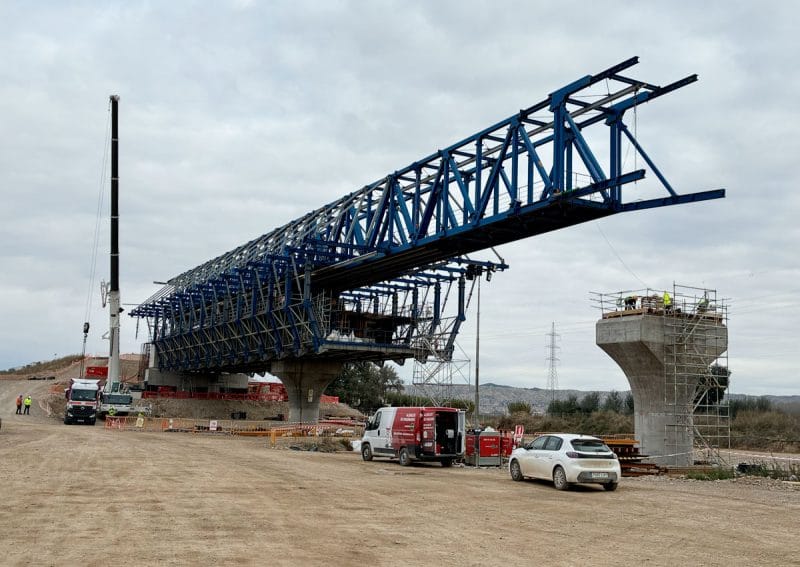 View of the first span already executed with the scaffolding system
All the foundations are deep and are constructed using piles with a 2 m diameter, with depths ranging from 35 to 45 m, to reach the more competent tertiary substrate located beneath the river’s alluvial bed. The excavations for the pile caps have generally been carried out with the protection of sheet piling, notably at Pier 9, the closest to the river, where it has been necessary to use the jet grouting technique to create a bottom plug.
The piers, with heights varying between 6 and 12 m, are circular with the exception of one, which is designed as a solid pedestal because, due to the deck´s depth above it, it is substantially lower. The primary constraint in the design of the piers has been their positioning, avoiding supports in the river and in meeting the requirements imposed by the Environmental Impact Declaration.
At the top, the piers open with a “palm tree” shaped capital to accommodate the two supports on each one. Thus, their maximum dimensions maintain the 3 metres in the longitudinal direction, which is the minimum external diameter of the piers, and reaching 6.3 metres in width in the transverse direction. These capitals, as is normal, allow for a recess for the inspection of the supports from the deck and a space necessary for the jacking of the deck, should the replacement of any support be necessary during the structure´s service life.
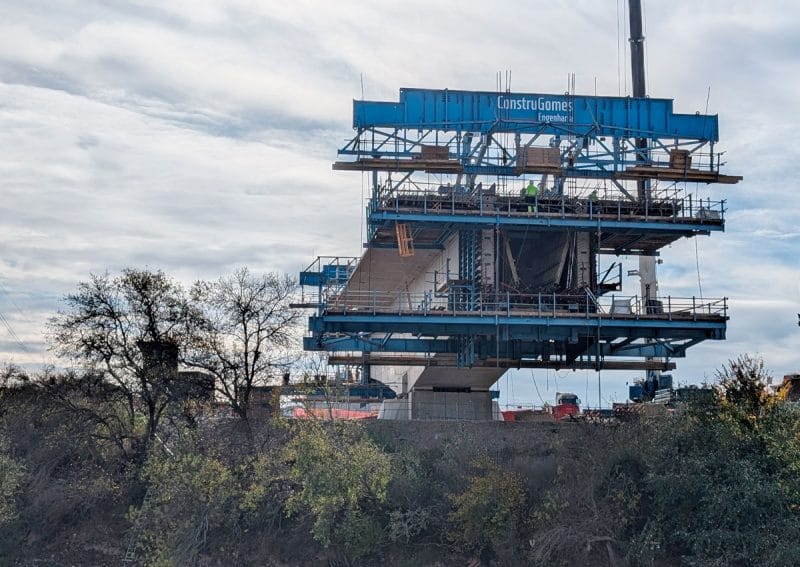 Cantilever over the Ebro River from Pier 10
The supports are of the POT type for maximum loads on piers of between 27,000 kN and 78,000 kN. All of them are free lengthwise and with a transversely guided support per pier.
The abutments are closed with wing walls. On the movable side, towards Pamplona, a track device will be installed, and the fixed side, towards Zaragoza, will be connected to the deck using prestressed tendons and, as usual, features longitudinal supports arranged vertically, also of the POT type, and a tensioning chamber.
Work is progressing at a steady pace and is due to be completed in 2026. All of the foundations have already been executed and the work on the piers is nearing completion. In the section of deck to be constructed with self-launching formwork, the first span has been executed and, in the cantilever sections, approximately half of the progress from Pier 10 has been completed, with fold 0 of Pier 8 finished, and work is underway on fold 0 of Pier 9.
From the Structural Department, we would like to thank the construction team, our colleagues from Zaragoza who participate as specialist technicians, and the construction management of Adif for theopportunity and their support during the visit. We have been able to learn from the challenges that arise when materialising projects on site and how some of the details we implement can influence the process in a way that makes carrying out construction work simpler.